
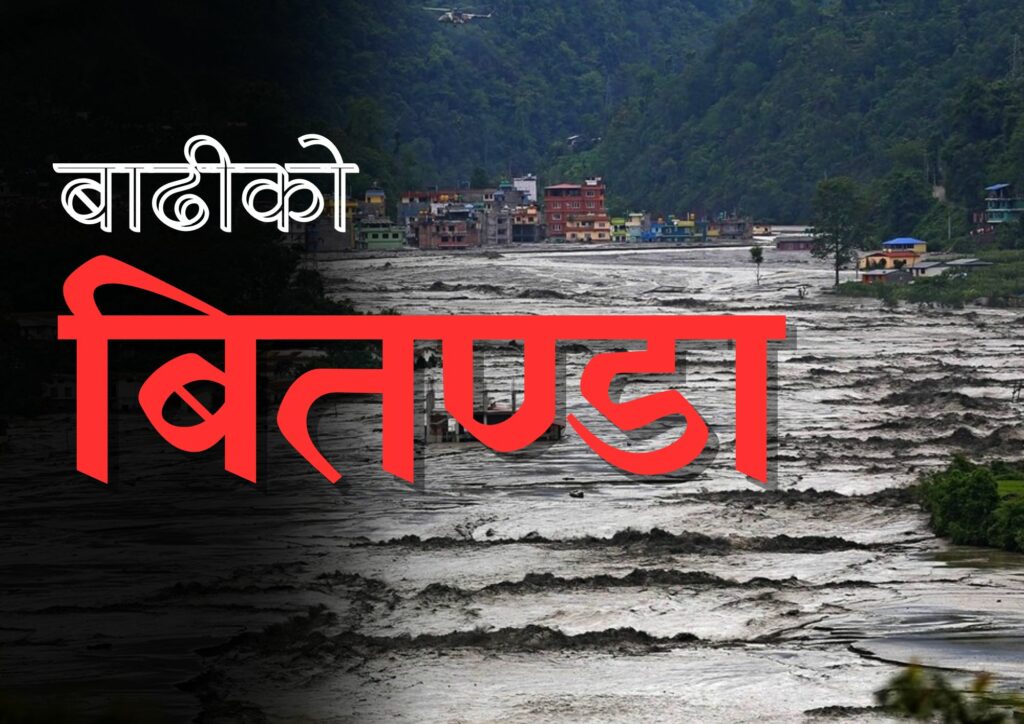
Three Days of Rain Kill 21, 5 Still Missing; Bridges and Hydropower Suffer Massive Damage
Three days of continuous heavy rainfall, floods, and landslides across the country have killed 21 people, while 5 remain missing. With the Kali Gandaki suspension bridge swept away and 1,013 megawatts of electricity supply halted, the country has suffered massive infrastructure damage.
Kathmandu — Continuous heavy rainfall across the country over the past three days has caused floods, landslides, and lightning strikes that have killed 21 people, while 5 remain missing. According to Prime Minister Balendra Shah, the incessant rain, floods, landslides, windstorms, inundation, and lightning since Asoj 8 have caused massive loss of life and property across various parts of the country. A total of 439 monsoon-related incidents have been registered nationwide.
Districts reporting human casualties include Myagdi, Dolpa, Dhanusha, Palpa, Baglung, Lamjung, Rukum West, Kavre, Dhading, Makwanpur, and Surkhet, among others. Free treatment arrangements have been made for the injured, and the search for the missing is ongoing. It has been reported that people went missing after being caught in an avalanche in Manang, and details are still being collected.
Based on the Department of Hydrology and Meteorology's forecast of heavy rainfall from Asoj 9 to 12, the government issued precautionary appeals and activated the National Disaster Risk Reduction and Management Authority and all 77 district command posts. Along with decisions to halt nighttime transportation and close schools, security personnel conducted on-site public announcements to disseminate early warnings in riverside and high-risk areas. Thanks to the government's early warnings, trekkers and students in the Himalayan region were able to remain safe.
Major Highways Blocked, Kali Gandaki Suspension Bridge Swept Away
Due to the continuous rainfall, more than a dozen roads connecting the Kathmandu Valley — including the Prithvi Highway, BP Highway, and Kanti Lok Marg — have been affected by landslides and subsidence. After floodwaters swept away a cruise ship — taller than a two-story building — that had been operating toward Bharatpur along the Narayani River bank and lodged it against a bridge, the East-West Highway was closed as a precaution. The Kali Gandaki suspension bridge was swept away by the flood. After water levels rose in the Mahakali River in the Far West, Nepal–India movement through the Gaddachauki border point in Kanchanpur was halted, and vehicular traffic was stopped on both sides of the bridge. With water levels rising in the Seti, Narayani, Kamala, and Kulekhani areas, transportation has been controlled with heightened vigilance.
1,013 Megawatts of Electricity Generation and Supply Halted
Due to floods and landslides affecting transmission lines in the Kali Gandaki Corridor, Marsyangdi, and Seti–Madi Corridor, a total of 1,013.2 megawatts of electricity supply has been halted. According to Minister for Water Resources and Energy Biraj Bhakta Shrestha, 318 megawatts has been completely shut down due to transmission line towers collapsing, while 695.2 megawatts has been halted as a protective measure in light of potential risks. He stated that technical teams have already been deployed to affected areas to restore electricity supply as soon as possible. In addition, hailstorms and rainfall have caused massive damage to farmers' paddy and vegetable crops.
As the risk has not yet subsided, the government has urged residents of riverside and hilly areas to exercise high vigilance and avoid travel except for essential work. Citizens in distress can contact the free toll-free number 1234.
Prime Minister Shah has warned that strict surveillance is being maintained on those spreading misinformation, violating victims' privacy, or engaging in black marketeering during this time of disaster, and that strict action will be taken against those involved in such illegal activities.