
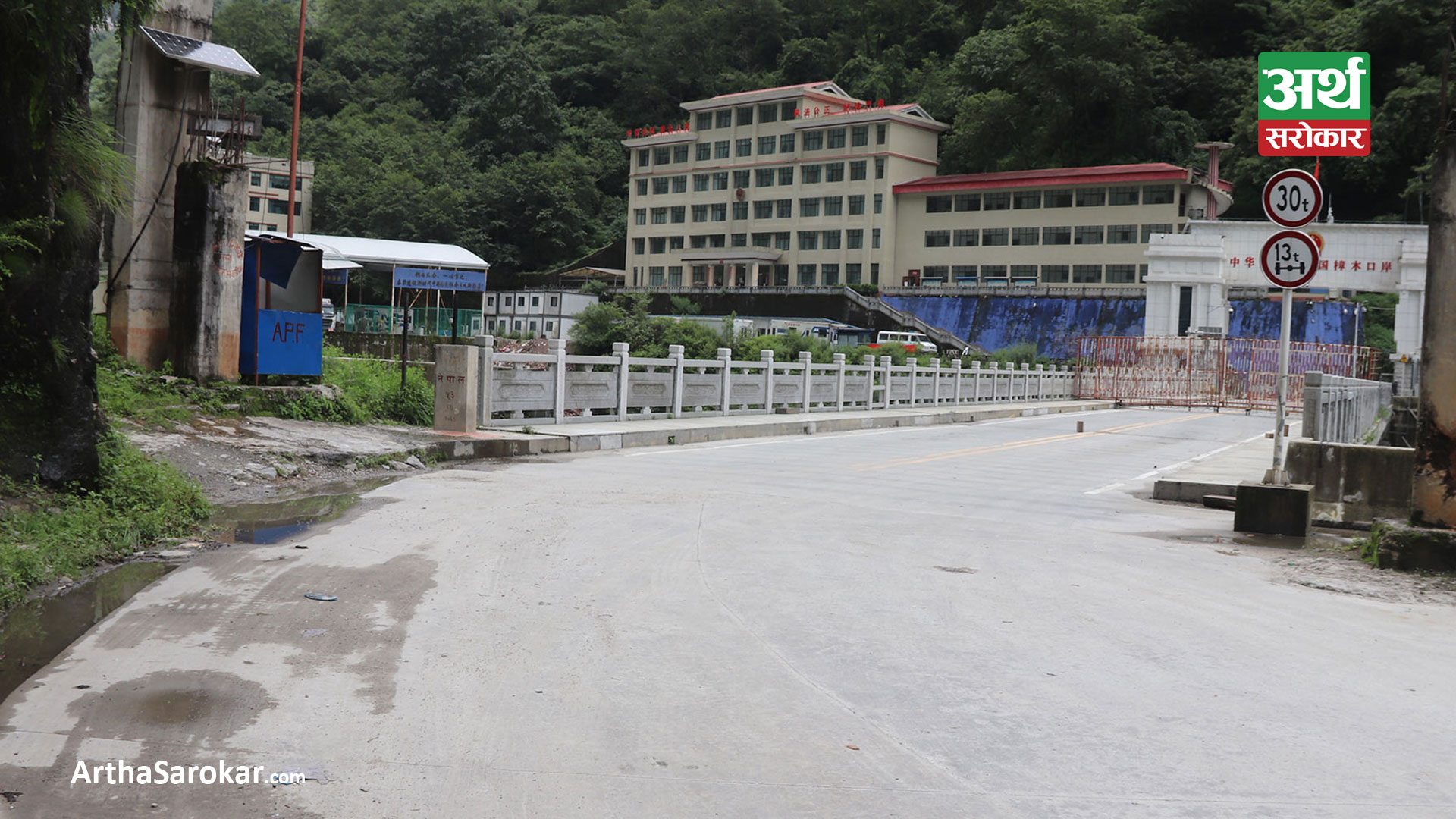
Tatopani Border Point: Questions Arise Over China's 'Road Problem' Argument as Nepal Says Road is Open
As delays continue in operating the Tatopani border point, a key Nepal-China trade route, Nepali authorities say the road on the Nepali side is passable. This has raised questions over the 'road problem' argument put forward by the Chinese side. There is growing demand for China to publicly provide a clear technical basis for keeping the border closed.
Kathmandu. As delays continue in operating the Tatopani border point, a crucial land route for Nepal-China trade, questions have arisen over the Chinese side's argument citing the road on the Nepali side as the reason.
According to Narayan Datta Bhandari, chief engineer of the Road Division Office, Charikot, there is currently no major obstruction on the Nepali side of the road for operating the Tatopani border point. He said that although minor maintenance and repairs are needed in some places, the situation does not warrant halting vehicular movement for that reason.
He stated that the necessary maintenance and repair work can be completed in a short time. This has raised further questions about the real reason behind the delay in operating the border point.
If the road on the Nepali side is in a condition suitable for vehicular movement, it seems the Chinese side should provide clear information on what else is preventing the full operation of the border point.
The Tatopani border point is Nepal's old and important trade route connecting Kathmandu to Tibet, China, via the Araniko Highway. However, this route has been repeatedly obstructed due to landslides, floods, river cutting, and road damage.
Recently, the Nepali side has been deploying equipment for road maintenance, removing landslides, and improving necessary infrastructure. In the past, even when a major landslide occurred in the Kodari area, the road was opened by deploying bulldozers, excavators, loaders, and tippers.
Impact of Goods Stuck on the Chinese Side
When the Tatopani border point remains obstructed for a long time, it directly affects Nepal-China trade. When containers coming from China to Nepal are held up, traders' transportation and storage costs increase.
If the border point is obstructed on the eve of major festivals like Dashain, it can also affect the supply of clothes, shoes, electrical goods, machinery, and daily consumer items. Traders are concerned that the impact may ultimately be seen in market prices.
If There is a 'Road Problem', Technical Basis Should Be Made Public
If the Chinese side considers road safety as the reason for obstructing the operation of the border point, it seems necessary to clarify where the problem is, what kind of risk has been identified, and what criteria must be met to open the border.
If the technical basis is made public in this way, it will be easier to resolve the dispute regarding the operation of the border point in a fact-based manner.
The problem of the Tatopani route is not new. The road has been repeatedly obstructed due to natural disasters. Therefore, a long-term and clear mechanism seems necessary between Nepal and China for border point operation, emergency management, and infrastructure maintenance.
For Nepal, Tatopani is not just a border point but an important route linked to national trade and the supply system. Therefore, to make its operation predictable, Nepal needs to hold further discussions with China on a clear operating protocol and criteria for closing and reopening the border point.
Additionally, there is a need to prioritize infrastructure development and expansion of alternative trade routes at the Rasuwa Gadhi and Korala border points alongside Tatopani. Excessive reliance on a single border point can have a major impact on Nepal's supply system due to natural disasters or border management decisions.
If the road on the Nepali side is in an operable condition, the main question now is what is causing further delay in operating the Tatopani border point. If the road itself is the problem, a clear technical description should be provided; and if the problem has been resolved, the Chinese side should clarify the reason for the delay in operating the border point.