
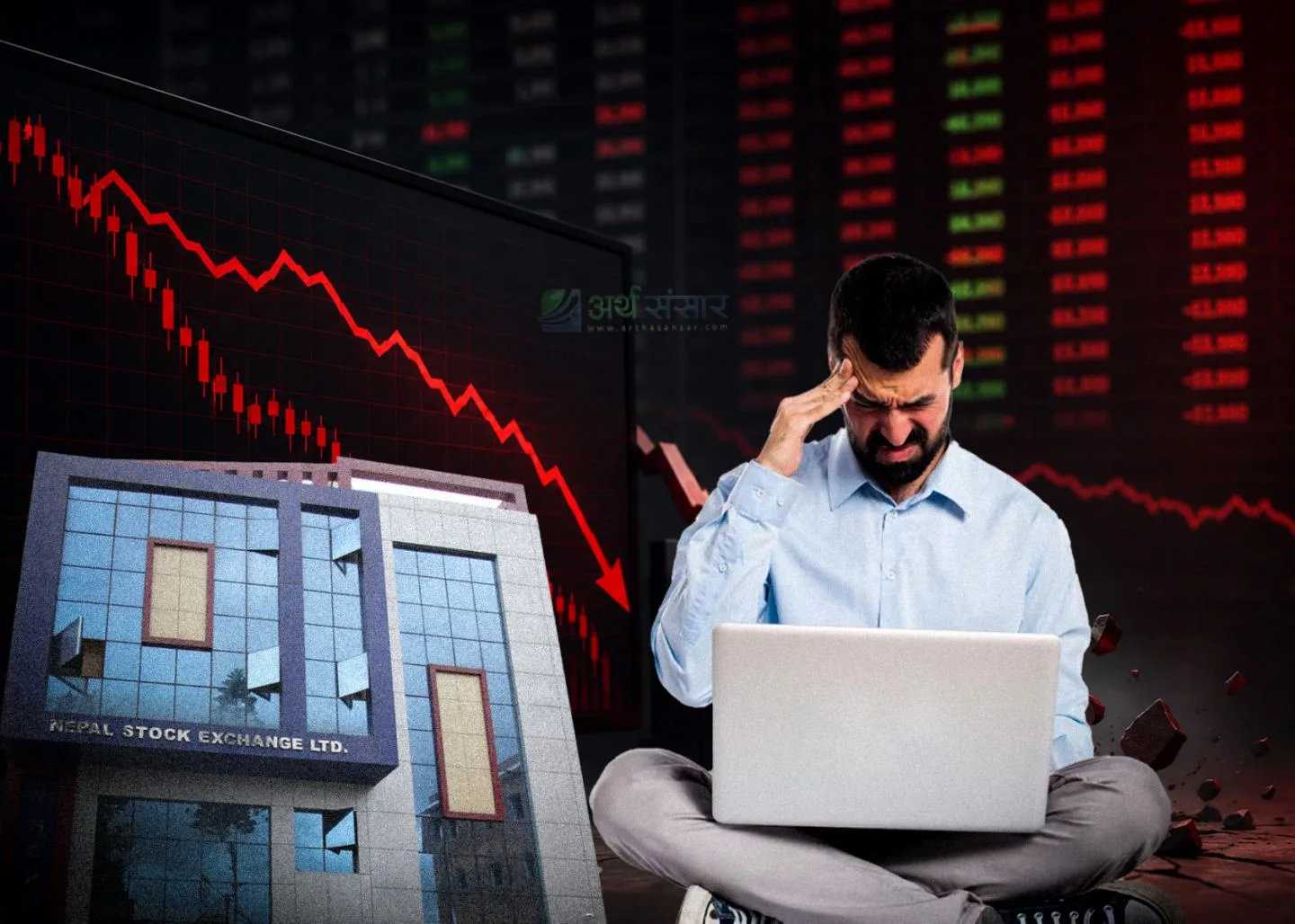
Share market continues to slide as festivals approach – What are the chances of a recovery before Dashain?
As Dashain nears, the Nepali share market is on a continuous downward trend. With regulatory arrangements and investor confidence weak, the market is stuck at the **2500** level. Experts say there is little chance of a major recovery before Dashain.
Kathmandu — As Dashain approaches, the Nepali share market is on a continuous downward trend. Ghatasthapana falls next Sunday, marking the formal start of Dashain. However, since government offices will remain open until the following Friday, the share market will be open for only about 5 days before Dashain.
Historically, the share market has tended to decline during the Dashain period. Investors also say there is no possibility of a major rise in the market before Dashain. The market is currently at a very low point and has remained around the 2500 level for the past two weeks. Although the regulatory body Nepal Securities Board (SEBON) appears to have done a lot of work to reform the capital market, the market has not been able to rise.
Former President of the Nepal Investor Forum, Chhotelal Rauniyar, says the market is unlikely to rise above this situation as Dashain approaches. According to him, just as the market was about to become clean, the 5 percent limit and the 15-day notice provision caused a contraction in the market.
‘The market was in a phase of becoming clean. But the 5 percent and 15-day provisions created further problems. Now big investors are not even buying shares,’ Rauniyar said.
According to him, a person who buys 100,000 shares of a company with 10 million shares also becomes a basic investor, and the provision requiring them to issue a 15-day notice again to sell shares has panicked investors.
General Secretary of the Nepal Share Market Investors Association, Rabin Kandel, says there is no possibility of a major rise in the market under the current situation. He said the share prices of good companies have not fallen, but the market has declined because the share of weak companies is large.
‘The prices of companies with good fundamentals have not fallen even now. The prices of weak companies fell. Since their share is also large, the market has fallen,’ Kandel said.
According to him, the declining performance of companies in the finance and hydropower sectors has dragged the market down.
Another investor, Rishiraj Bhetwal, said the market has not been able to gain momentum because people in regulatory leadership speak recklessly. He said that in the current situation, the market appears likely to remain sideways even during Dashain.
‘Due to the pressure of festivals and the month-end, the market seems likely to remain sideways,’ Bhetwal said.
He said there has been no serious discussion about the root cause of the market decline. He said the tendency to say one thing when meeting investors and another at public events has caused the market to fall.
‘Even though our market is sensitive enough to fall on ordinary news, and those in regulatory leadership should speak sensitively, they did not do so, and the market contracted,’ he said.
He said an environment of trust has not yet been created among investors.
It has been more than 6 months since the government was formed. Investors who had high hopes after a stable government came to power are becoming disappointed, and the government also needs to pay attention to this issue. The government must view this sector, which has more than 800,000 investors and a capitalization of over Rs 45 trillion, with extreme sensitivity.
Investors say the market has also been affected because the chairman, who retired from Nepal Rastra Bank, issues circulars daily just like the central bank. Investors say that instead of issuing circulars frequently and speaking unnecessarily about the capital market, one should speak with ease.