
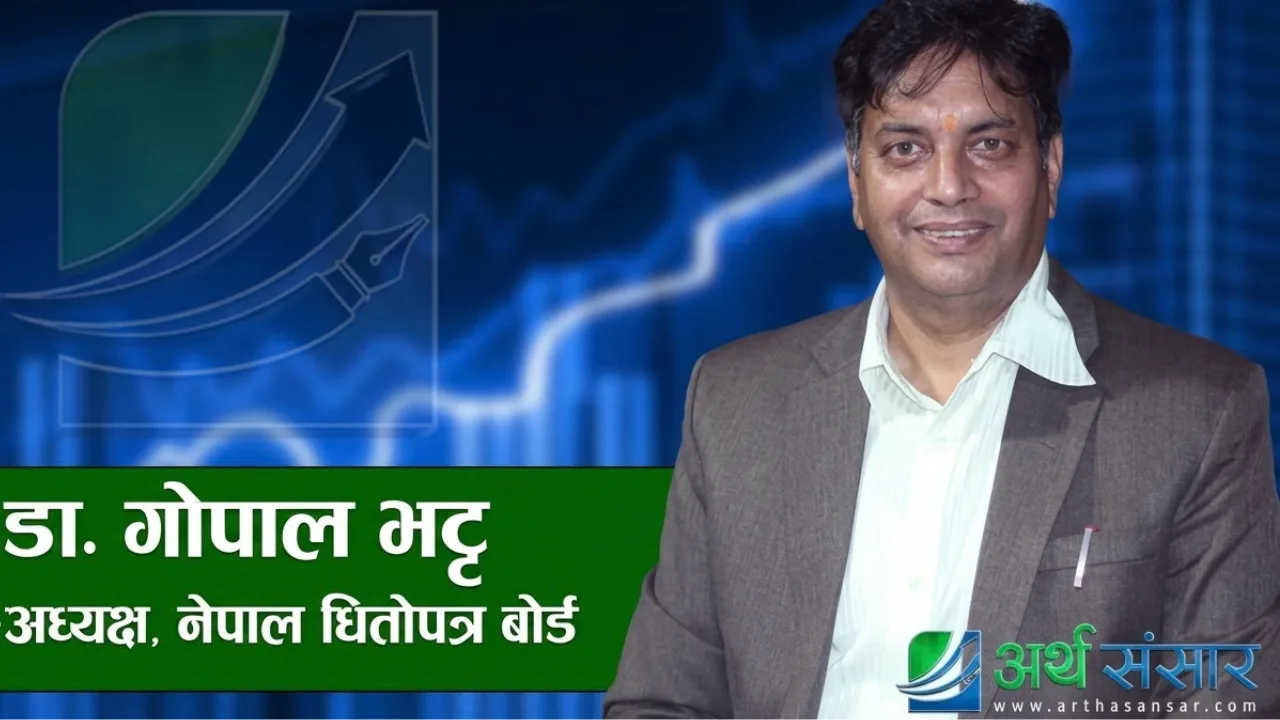
SEBON Chair Bhatta clarifies 15-day notice rule for fundamental shareholders: 'We are ready to review'
Nepal Securities Board (SEBON) Chair Gopal Bhatta has clarified that the requirement for fundamental shareholders to give 15 days' notice before selling 5 percent or more shares is not intended to push the market up or down. He said the rule was introduced for transparency and to curb insider trading, and indicated readiness to review it if needed.
SEBON Chair Gopal Bhatta has clarified that the requirement for fundamental shareholders to give 15 days' notice before selling 5 percent or more shares is not intended to push the market up or down.
Bhatta made the clarification after a heated debate in the stock market over the directive SEBON sent to listed companies on Bhadra 9. According to him, the rule was introduced not to influence the market index but to ensure that important information held by shareholders with large holdings is made public in a timely manner.
"The notice we issued was not meant to prevent market development, or to make the NEPSE index go down or up. We issued this directive regarding disclosure requirements," Bhatta said.
According to SEBON's directive, if a fundamental shareholder needs to sell 5 percent or more shares, they must inform the concerned company at least 15 days in advance. Investors are divided over whether this rule applies only to promoter shareholders or also to investors who became fundamental shareholders by buying shares in the secondary market.
Chair Bhatta said that since shareholders with large holdings possess information and the capacity to influence the market, the rule was brought with the concept that they must disclose their intention to sell shares.
"If you are a fundamental shareholder, if you have a large holding, you have significant information. So we said, inform us that 'I am selling,'" he said.
Claim of giving more time than international practice
Chair Bhatta claimed that in developed countries' practices, the time given for such disclosures is comparatively shorter, but in Nepal, the 15-day period was set to provide investors with sufficient time.
According to him, regulations brought by the regulator are not permanent and unchangeable. He said rules and directives can be reviewed based on market needs, investor feedback, and the impact of the arrangement.
"The regulations we bring are not always like lines drawn in stone; they can change. But we must see whether it is necessary, or whether such an information disclosure system exists internationally," Bhatta said.
He also indicated that if investors find the current arrangement unsuitable, it can be reviewed through discussion. According to him, if investors feel this disclosure system is not needed, they can discuss it with the regulator.
"If this information disclosure system does not seem good, if investors do not want the disclosure requirement, we will also discuss with investors," he said.
'Insider information' is the bigger problem
Bhatta said the arrangement SEBON has currently brought is not the entire regulatory system but only a small component of disclosure. According to him, managing insider information in the Nepali stock market remains a bigger challenge.
"We have not even brought a regulation for insider information yet. That is the biggest problem in the stock market. When we brought a small component for that, a big uproar was created," he said.
According to him, it is also necessary to look at how important information in the market is made public, how to make transactions by large holders transparent, and how to control the misuse of insider information.
'Even if the index rises, investors' problems won't end'
SEBON Chair Bhatta also commented on the tendency to present various regulatory arrangements and government policies as the main reason for the market falling recently.
He said it is wrong to think that all investors' problems will be solved once the market index reaches a certain level. Since investors' expectations keep rising even after the market rises, he said market problems cannot be solved by merely focusing on the index level.
"Even if it reaches five thousand, it won't be solved, remember this. The nature of the market is such that the index must always keep rising here; there is no question of it falling," Bhatta said.
He said that even if the market reaches 6,000 or 8,000 points, investors' expectations will go even higher, and problems related to the index and returns cannot be solved merely by raising the market.
"Even if it reaches 6,000, there will be those who quarrel. If it reaches 8