
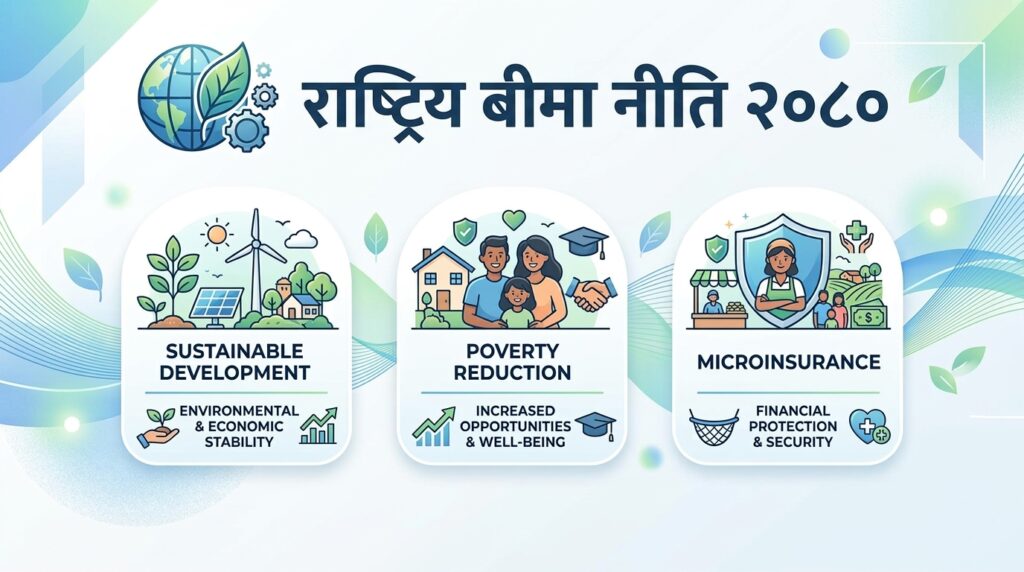
Policy to Link Insurance Sector with Sustainable Development and Poverty Reduction, and the Role of Microinsurance
The Government of Nepal's 'National Insurance Policy, 2080' has set a visionary goal of aligning the insurance sector with the Sustainable Development Goals and poverty reduction strategies. Policy 9.7 under Clause 10.7 of the policy creates a policy foundation to provide economic security to the poor, reduce risks for small enterprises, and manage climate and natural disaster risks. Although microinsurance can play a significant role in low-income and rural economies, challenges such as lack of financial literacy persist.
Kathmandu. The insurance sector is the backbone of risk management in the economy. It contributes directly to economic growth, social security, and disaster risk reduction. The 'National Insurance Policy, 2080' approved by the Government of Nepal has set a visionary goal of expanding insurance access in Nepal and bringing poor and low-income groups into the fold of economic security.
The main objective of the policy is to align the insurance sector with the national Sustainable Development Goals and poverty reduction strategies. In this context, an analytical review of the development and contribution of the insurance sector is presented here in light of the Nepal Insurance Authority's study on microinsurance and existing policy efforts.
1) Analysis of National Insurance Policy, 2080, Clause 10.7, Policy 9.7
Policy 9.7 under Clause 10.7 of the National Insurance Policy 2080 has prepared a policy foundation to connect the insurance sector with the country's overall economic and social transformation.
- (a) Contribution to achieving sustainable development goals and poverty reduction: Insurance helps break the cycle of poverty. When a disaster or accident occurs, poor families are at risk of falling back into deep poverty. Insurance compensates for such economic loss and directly supports achieving sustainable development goals, decent employment for poverty eradication, and economic growth.
- (b) Reducing business risks of micro and small industries and creating employment: Micro, cottage, and small industries are the foundation of the economy. Insurance services free small entrepreneurs from the fear of potential fire, theft, or loss, creating an environment for confident investment. This creates new employment opportunities along with industrial stability.
- (c) Linking climate change risks with insurance services: The risk of excessive rainfall, drought, and unseasonal floods and landslides has increased due to climate change. Innovative tools such as weather index-based insurance help provide economic security to farmers and communities at environmental risk.
- (d) Special insurance for reducing risks from natural disasters: Nepal is a country at high risk of natural disasters. To manage the impact of disasters such as earthquakes, floods, and landslides, special catastrophic insurance or special natural insurance schemes are provided to enhance community resilience.
- (e) Geographical and social diversification and localization of insurance policies: To extend city-centric insurance services to villages, insurance schemes tailored to geography and local needs—such as livestock insurance for Himalayan regions and flood insurance for the Terai—are formulated to localize insurance services.
- (f) Premium discounts and special facilities for citizens below the poverty line: To bring economically disadvantaged groups into the insurance fold, incentive arrangements such as government subsidies or premium discounts are made to ensure equitable access.
- (g) Expansion to at-risk entrepreneurs, small farmers, producer groups, and cooperatives: Small farmers, agricultural cooperatives, and small producer groups are at financial risk. A strategy has been adopted to expand insurance coverage through cooperative and group insurance models to include them.
- (h) Insurance arrangements for Nepalis abroad: To ensure the security of millions of Nepali citizens in foreign employment and their families, term life insurance is made mandatory and simple, ensuring social security for migrant workers.
2) Prospects and Challenges of Microinsurance
According to a study conducted by the Nepal Insurance Authority for the expansion and development of microinsurance, microinsurance is a reliable means for low-income groups and the rural economy. The main prospects and challenges highlighted by the study are as follows:
Prospects
- Broad market and large population: A large population of Nepal (especially rural and low-income groups) is still outside the reach of insurance, so the market scope for microinsurance is very broad.
- Demand in agriculture and livestock sector: There is high demand for agricultural and livestock microinsurance to protect the large population dependent on agriculture from climate risks and diseases.
- Financial inclusion and technology: The expansion of microfinance institutions, cooperatives, and digital payment systems has made it easier to deliver microinsurance to remote areas.
- Establishment of specialized microinsurance companies: The licensing of separate microinsurance companies (micro insurance companies) has brought special attention and innovation to this sector.
Challenges
- Lack of financial literacy and awareness: There is a lack of awareness and understanding of the importance of insurance among the target groups.