
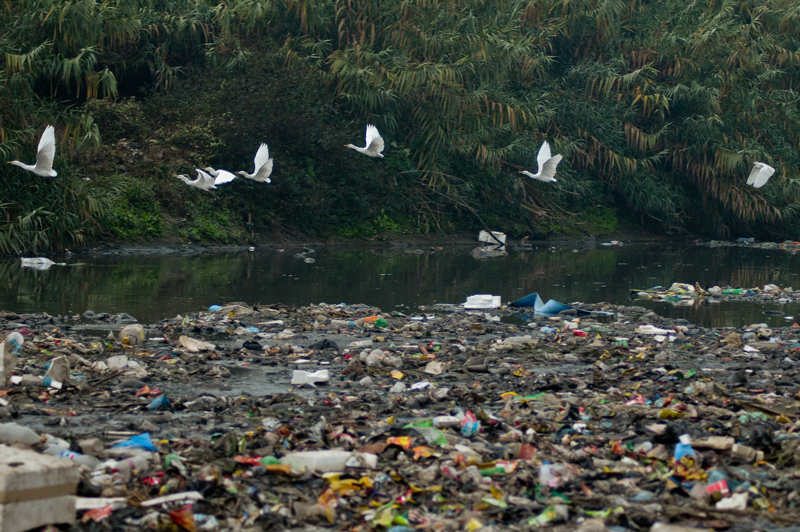
Nepal's Supreme Court Orders Nationwide Enforcement of 40-Micron Plastic Bag Ban
Nepal's Supreme Court has issued a mandamus directing the government to fully enforce the ban on plastic bags thinner than 40 microns across the country. The verdict cites weak coordination, regulatory delays, and inadequate institutional capacity as key barriers, and mandates a centralized database, extended producer responsibility, and a 50 percent recycling target.
KATHMANDU, Sept 30 — Nepal's Supreme Court has ordered the government to fully enforce nationwide the ban on the production, import, sale, distribution, and use of plastic bags thinner than 40 microns, ruling that delays and weak coordination among government agencies have undermined implementation of the restriction.
A joint bench of Justices Hari Prasad Phuyal and Abdul Aziz Musalman issued the mandamus along with a series of directives requiring the government to strengthen regulation of plastic production and waste, establish a centralized database of plastic producers and importers, enforce extended producer responsibility, and improve coordination among the federal, provincial, and local governments.
The apex court said controlling plastic pollution is linked to the constitutional right to live with dignity and the fundamental right to a clean and healthy environment.
The verdict noted that the government had already announced the ban through various policy and budgetary measures, including:
- Point 160 of the fiscal year 2021/22 budget
- The Plastic Bag Prohibition Action Plan 2021
- Point 118 of the fiscal year 2025/26 budget
However, the SC found that the ban had not been effectively implemented. The apex court said the government had not been completely inactive, but its efforts had been delayed, fragmented, and institutionally inadequate.
Among the problems identified by the SC were the lengthy process of formulating the directive required to implement the ban, the absence of a systematic database of plastic industries, delays in providing grants to industries seeking to upgrade their technology, and limited monitoring capacity at the local level.
The apex court also said responsibilities and financial obligations among the three tiers of government had not been clearly defined for enforcing the plastic restriction and managing plastic waste.
Key Directives
The verdict directs the government to enforce the 40-micron restriction continuously, effectively, and without discrimination across the country. It has also ordered the government to study and establish standards for regulating the production, import, sale, distribution, and use of microplastics and microbeads.
The government must establish a centralized database of plastic producers and importers and introduce mandatory registration, production records, and annual reporting requirements.
The SC has also ordered the effective implementation of extended producer responsibility (EPR) for plastic bags and packaging. It has directed the government to set a recovery and recycling target of at least 50 percent and establish an integrated information system to monitor compliance.
The verdict further calls for a dedicated body under the Ministry of Industry, Commerce and Supplies, equipped with the necessary human resources and budget, to continuously monitor and regulate industries involved in producing, importing, distributing, and using plastic products.
The apex court has ordered the government to clearly divide responsibilities and financial obligations among the federal, provincial, and local governments and prepare model legislation to support implementation of the plastic restrictions.
Local governments should be given the technical capacity and resources necessary to enforce the restrictions, including the authority to impose fines where required, the apex court said.
Transitional Support and Accountability
The verdict also calls for transitional support for industries affected by the restrictions. The government has been directed to provide technology transfer, capital grants, and tax and customs concessions to industries producing plastic bags of 40 microns or thicker and environmentally friendly alternatives.
The SC has further ordered the government to apply the "polluter pays" principle and take action, including fines or suspension of licenses, against industries that fail to meet prescribed targets.
It has also directed the establishment of systems for waste segregation at source.