
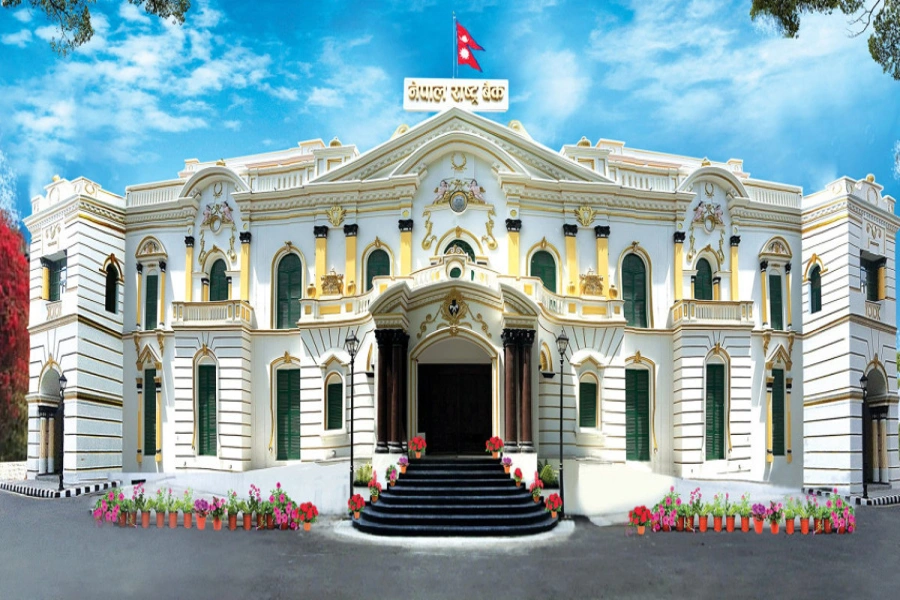
Nepal's Finance Committee Retains Government Power to Direct Central Bank, Raising Autonomy Concerns
Nepal's House Finance Committee has unanimously endorsed a bill amending the Nepal Rastra Bank Act, keeping a controversial provision that allows the government to issue directives to the central bank. Former governors warn this could undermine NRB's autonomy, while the committee also proposes shortening the governor's term and tightening qualification requirements.
KATHMANDU, Sept 19 — The House of Representatives' Finance Committee has unanimously endorsed a report on a bill to amend the Nepal Rastra Bank Act, 2002, retaining the existing provision that allows the government to issue directives to the central bank on monetary, banking and financial matters.
Former governors and other stakeholders have raised concerns that retaining the provision could increase government intervention in Nepal Rastra Bank (NRB) and affect its autonomy.
Section 106(c) of the existing Act allows the government to issue directives to NRB on matters related to currency, banking and finance. The provision has been retained in the amendment bill.
The committee has also proposed reducing the governor's term from five years to three years. Under the proposed provision, the government could reappoint the governor for an additional two years based on a performance evaluation. The same arrangement would apply to deputy governors and board members.
Finance Committee Chair Dr Krishna Hari Budhathoki said the report was unanimously endorsed on Wednesday following clause-by-clause discussions based on suggestions received from committee members. Members can submit additional suggestions and views in writing to the committee secretariat, he said.
Related story
- Revised interest rate corridor system introduced
Former governors Maha Prasad Adhikari and Dr Tilak Rawal have said that retaining the government's power to issue directives could affect the central bank's autonomy.
Adhikari was suspended by a Cabinet decision on April 7, 2022, and returned to office on April 21, 2022, following a Supreme Court order. He subsequently completed his five-year term.
There had also been disputes between the government and NRB over their respective jurisdictions in the past. In September 2000, the government removed then-Governor Dr Tilak Rawal and appointed Dipendra Purush Dhakal as governor. Rawal returned to the post about nine months later following a Supreme Court order.
During Rawal's tenure, NRB had blocked the government's attempt to use funds beyond the overdraft limit prescribed by law.
The process of financial-sector reform, supported by the World Bank, International Monetary Fund and Asian Development Bank, began in fiscal year 2000/01. Making NRB more autonomous, removing the finance secretary as an ex-officio member of its board and eliminating the government's power to issue directives to the central bank were among the issues emphasized during the reform process.
Former governors have said the Nepal Rastra Bank Act, 2022, was subsequently drafted with these objectives, although the provision giving the government authority to issue directives was later included.
The committee has also revised qualification and experience requirements for the governor, deputy governors and independent directors. Under the proposed provision, candidates would need at least a master's degree or equivalent in economics, monetary studies, banking, finance, statistics, public administration, commerce, management, commercial law or accounting, along with at least four years of relevant experience.
A former chief executive officer of a commercial bank would also be eligible to become governor after completing a two-year cooling-off period.
The committee has proposed barring anyone holding more than 0.5 percent shares in a bank or financial institution from becoming governor or a director of NRB. The existing threshold is 5 percent, while the original bill had proposed a 1 percent threshold.
The NRB Board would continue to have seven members, but at least one woman would be required to serve as an independent director. The committee has also proposed that monetary policy be announced every year on the first day of the new fiscal year.
The proposed amendments would also bring the Citizen Investment Trust, Employees Provident Fund and Social Security Fund under the regulatory and supervisory jurisdiction of NRB.