
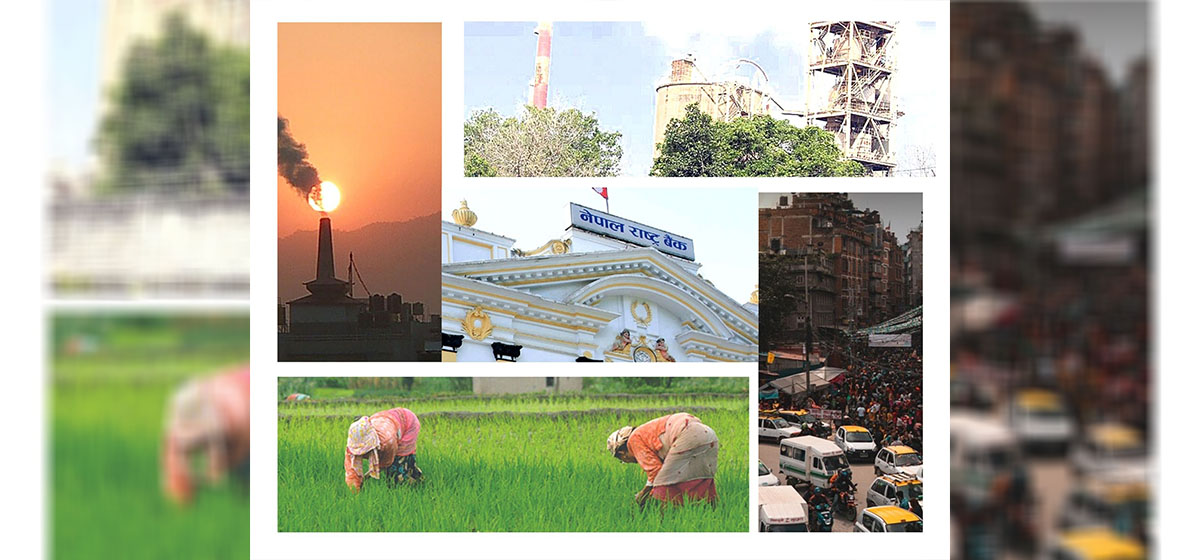
Nepal's Economy Gains in Remittances and Power, Falls Short on Jobs and Investment
Eleven years after its constitution, Nepal has strengthened foreign exchange reserves and hydropower exports, but repeated disasters and political instability have stalled job creation and private investment. The World Bank projects real GDP growth of just 2.3 percent for FY2025/26, with recovery expected in the following two years.
KATHMANDU, Sept 27 — Nepal recently marked 11 years since the promulgation of its Constitution, a period that has brought major changes to the country's political and economic structures. Federalism has been implemented, electricity generation has expanded, and foreign exchange reserves and remittance inflows have strengthened.
However, the economy has struggled to create jobs, expand domestic production and attract private investment at the expected pace.
Since the Constitution was promulgated on September 20, 2015, the economy has faced a series of major shocks, including:
- The Indian blockade
- The COVID-19 pandemic
- Financial-sector pressures
- Political upheavals
- The September 2025 Gen Z protest
More recently, the Bhotekoshi and Trishuli floods have caused extensive damage to infrastructure and disrupted trade routes with China.
A few months before the Constitution was promulgated, the 2015 earthquake caused an estimated Rs 706.46 billion in damage, according to the National Planning Commission, and pushed an estimated 700,000 additional people below the poverty line. The subsequent blockade disrupted fuel supplies and industrial activity, while the COVID-19 pandemic caused the economy to contract by 2.12 percent in fiscal year 2019/20.
The September 2025 unrest caused an estimated Rs 84.46 billion in damage to historical, public and private infrastructure, further affecting economic activity.
Business leaders say repeated disasters and political instability have prevented the economy from achieving sustained growth. Former Nepal Chamber of Commerce President Rajendra Malla said the recent Bhotekoshi flood dealt a major blow to the economy and could make it difficult to achieve the government's 7 percent growth target for the current fiscal year.
Federation of Nepalese Chambers of Commerce and Industry Senior Vice President Sur Krishna Vaidya said economic activity had not advanced as expected over the past 11 years. He said the latest floods caused further damage to infrastructure and hydropower projects and warned that reconstruction would take considerable time.
The latest disasters have also triggered debate over shifting public spending priorities toward reconstruction, potentially slowing economic growth in the coming years. The loss of skilled workers and damage to infrastructure have added to the challenge.
There have, however, been notable gains. Electricity generation and exports have expanded, with hydropower emerging as one of the strongest areas of economic growth. The World Bank says nearly 385 megawatts of hydropower capacity was added to the grid in the first half of fiscal year 2025/26.
The World Bank estimates Nepal's economy grew by an average 4.2 percent annually between 1996 and 2023, with low productivity, weak private investment and slow job creation remaining major structural challenges.
Remittances have been one of the economy's strongest pillars. They averaged nearly 23 percent of GDP between 2012 and 2024 and reached 26 percent of GDP in 2024, helping strengthen household incomes and foreign exchange reserves. However, the World Bank says Nepal's heavy reliance on migration and remittances has not solved the underlying problems of domestic production and employment.
The World Bank projected Nepal's real GDP growth at 2.3 percent in fiscal year 2025/26, citing the effects of the September 2025 unrest, the Middle East conflict and slower agricultural growth. It expects growth to recover to an average 4.4 percent in FY2026/27 and FY2027/28, supported by reconstruction and continued hydropower expansion.
Nepal Rastra Bank data show that remittance inflows reached Rs 2.363 trillion in FY2025/26, while the balance of payments recorded a surplus of Rs 1.027 trillion. Foreign exchange reserves also remained strong.
The economic picture after 11 years is therefore mixed. Foreign exchange reserves, remittances and hydropower have emerged as pillars of stability, but job creation, domestic production and private investment remain the country's most pressing challenges.