
Nepal Rethinks Flood Warnings After 'Himalayan Tsunami' Exposes Gaps
Nepali authorities acknowledge that conventional flood warnings failed during the August 26 Bhotekoshi–Trishuli disaster, which they describe as a 'Himalayan tsunami.' Officials call for a fundamental shift in how scientific data is translated into actionable warnings and evacuation decisions.
KATHMANDU, Oct 2 — Government authorities have admitted that Nepal needs to fundamentally rethink how it warns communities about floods, as conventional early-warning messages may not be adequate for increasingly extreme disasters in the Himalayas.
Dr Dharma Raj Upreti, chief executive officer of the National Disaster Risk Reduction and Management Authority, made the remarks during a high-level dialogue on water security and resilience in Kathmandu on Thursday.
Upreti said the loss of life during the recent Bhotekoshi–Trishuli flood was partly linked to a widespread belief that floodwaters would remain confined to river channels and would not reach homes and settlements.
"People did not expect the Bhotekoshi–Trishuli flood to be so devastating," Upreti said, noting that some people even attempted to capture the unfolding disaster on social media and lost their lives in the process.
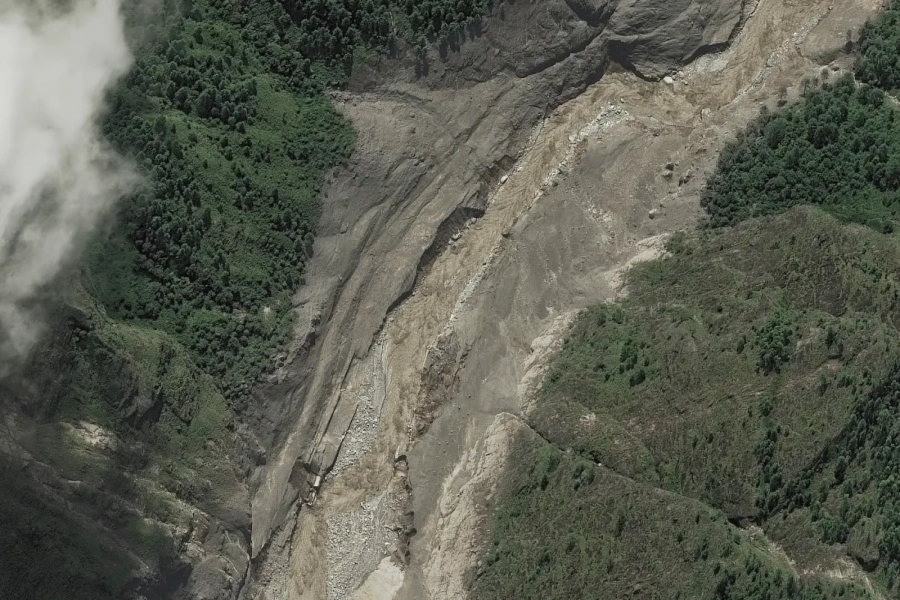
The August 26 disaster swept through the Bhotekoshi–Trishuli corridor in Rasuwa, killing people and causing extensive damage to roads, bridges, hydropower infrastructure and settlements.
Upreti said the disaster exposed the limitations of Nepal's traditional approach to communicating flood risks. For disasters of the scale witnessed in the Himalayas, simply telling people that a flood is approaching may not be enough, he said.
He described such an event as a "Himalayan tsunami" and called for a fundamental shift in the way scientific information is converted into warnings and evacuation decisions.
"We need to make science actionable during disasters," Upreti said, stressing that warnings must be designed in a way that enables communities and authorities to understand the severity of a threat and act quickly.
He also emphasized that disaster preparedness cannot be left to a single agency. Government institutions and other actors must clearly understand and fulfill their respective responsibilities before and during emergencies, he added.
Dr Mark Smith, director general of the International Water Management Institute (IWMI), said water connects food security, energy, public health, ecosystems and economic development, making the way Nepal manages its water resources critical to its future resilience and prosperity.
"To realize this potential, we must move beyond fragmented approaches and transition toward integrated, inclusive and mission-oriented water planning, decision-making and investment," Smith said.
He stressed that scientific evidence should guide policy, planning and investment, adding that stronger links between science, policy, investment and local action could help protect communities, reduce water-related risks and make water a driver of resilient and inclusive development.
Sushil Chandra Acharya, joint secretary at the Ministry of Energy, Water Resources and Irrigation, said Nepal continues to face constraints in financial resources, institutional and technical capacity, access to modern technology and sustainable decision-support systems.
He said Nepal should move beyond project-based interventions and ensure that technical skills, tools and institutional knowledge developed through partnerships remain within government systems after individual projects end.
"Long-term planning cannot be turned on and off with each project or funding cycle," Acharya said. "It requires continuity, institutional ownership and a stronger connection between policy, public investment and implementation."
He also called for stronger and more coordinated Nepali participation in regional and global discussions on water and climate, saying this requires clearly defined national priorities.
UAE Ambassador to Nepal Abdulla Saeed Mubarak Jarwan Al Shamsi warned that parts of the Himalayan region were approaching, or had already reached, what he called a stage of "water bankruptcy."
He called for "genuine reinvention" rather than incremental adjustments.