
Nepal-India Issue 24-Point Joint Statement with NPR 24 Trillion Development Assistance and 8 MoUs Signed
During Prime Minister Balendra Shah's first visit to India, Nepal and India issued a 24-point joint statement. India announced development assistance equivalent to NPR 24 trillion, and eight memorandums of understanding were signed covering energy, railways, transit, education, and border infrastructure.
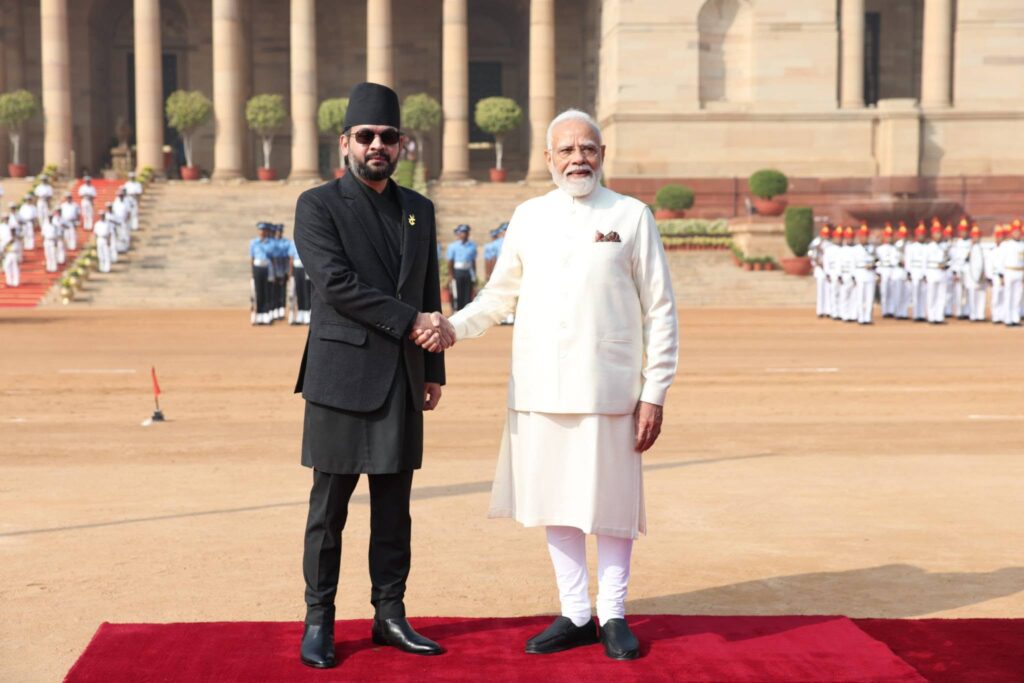
Kathmandu. During the two-day state visit of Prime Minister Balendra Shah to India at the invitation of Indian Prime Minister Narendra Modi, Nepal and India issued a 24-point joint press statement. This is Prime Minister Shah's first visit to India after assuming office.
During the visit, Prime Minister Shah was accorded a formal welcome with a 'Guard of Honor' at the Presidential Palace, and he laid a wreath at Mahatma Gandhi's memorial at Rajghat. He also had a courtesy meeting with Indian President Droupadi Murmu and held bilateral talks with his Indian counterpart Narendra Modi. Indian External Affairs Minister Dr. S. Jaishankar also met with Prime Minister Shah.
Key Agreements and Announcements
NPR 24 Trillion Development Assistance: India has announced development assistance totaling INR 15,000 crore (NPR 24 trillion) to support Nepal's development journey. Of this, INR 3,500 crore (NPR 5 trillion 60 billion) will be received as grants for post-disaster reconstruction and new infrastructure, and INR 11,500 crore (NPR 18 trillion 40 billion) as concessional loans (Line of Credit) for energy sector projects. The announcement of constructing an 'Agro-Industrial Park' in Chitwan with Indian grant assistance was also welcomed.
'Developed India and Prosperous Nepal' Joint Vision: Both Prime Ministers adopted a joint vision document titled 'Developed India and Prosperous Nepal' as a roadmap for future-oriented partnership. It covers areas including climate resilience, disaster management, sports, startups, digital services, space, and innovation.
Air and Transit Facilities: An agreement was reached to conduct technical consultations and decide on making the Bhairahawa-Kathmandu-Lucknow (B345) one-way air route two-way. For transit trade, India announced new access from Deendayal Port (Kandla) in Gujarat and, after necessary infrastructure is built, facilities at Paradip Port in Odisha.
Rail and Border Infrastructure: Both Prime Ministers jointly inaugurated the 'Saryu-Kamla Express' rail service between Ayodhya and Janakpurdham. They also announced the completion of the 'Field Location Survey' for the proposed Raxaul-Kathmandu electric broad-gauge railway and agreed to cooperate in constructing the East-West Railway. The virtual foundation stone was laid for an Integrated Check Post at Banbasa, and a new motorable bridge connecting Dharchula in India and Darchula in Nepal was inaugurated.
Petroleum and Hydropower: The second phase of the Motihari-Amlekhgunj petroleum pipeline was inaugurated, and the virtual foundation stone was laid for a petroleum terminal in Jhapa. In the energy sector, the virtual foundation stone was laid for the 669 MW Lower Arun Hydropower Project, and directives were given to expedite the DPR of the Pancheshwar Multipurpose Project and advance work on the Saptakoshi and Sunkoshi projects. Satisfaction was expressed over the progress of the Inaruwa-New Purnia and Dododhara-Bareilly transmission lines.
IIT Campus in Nepal: Expanding educational and technical cooperation, India agreed to establish an 'off-shore' campus of the Indian Institute of Technology (IIT) in Nepal.
Border Management: Commending progress in the repair and maintenance of border pillars, both countries' foreign secretaries were directed to work on remaining border-related issues.
8 Memorandums of Understanding (MoUs) Signed
During the visit, eight important memorandums of understanding were exchanged between Nepal and India:
Academic and research cooperation between the National Forensic Sciences University (Gujarat) and the Crime Investigation Department of Nepal Police.
Cooperation between the National Defence University (India) and the National Police Training Academy (Nepal).
Capacity-building training program for civil servants between the National Centre for Good Governance (India) and the Nepal Administrative Staff College.
Cooperation in the field of Ayurveda and traditional medicine systems.
Establishment of a 'SATCOM' network for South Asian geostationary satellite use between the Indian Space Research Organisation and Nepal's Ministry of Communication and Information Technology.
Technical cooperation in the field of sustainable urban development.
Cooperation in the field of health and pharmaceutical sciences.
Cooperation in the field of livestock and fisheries development.