
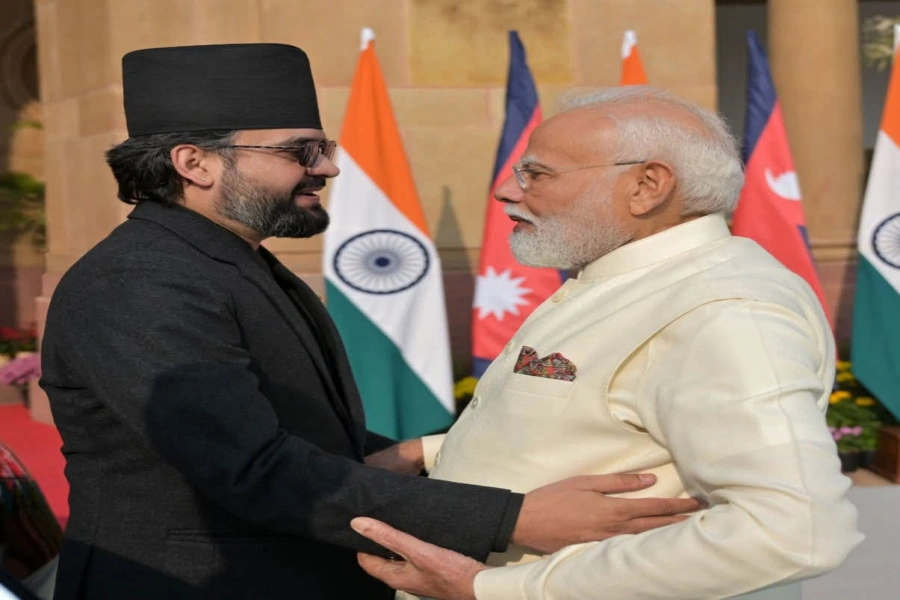
Nepal and India Forge 10-Pillar Partnership Vision During PM Shah's State Visit
Nepal and India have adopted a joint vision document, 'Viksit Bharat and Samunnat Nepal: Re-imagining the Partnership,' outlining cooperation across 10 key areas during Prime Minister Balendra Shah's two-day state visit to India. The agreement includes INR 15,000 crore in Indian development assistance to Nepal, commitments to modernize the 1950 Treaty of Peace and Friendship, and expanded cooperation on connectivity, energy, trade, and technology.
KATHMANDU, Nov 23 — Nepal and India have agreed to reshape their bilateral partnership through a forward-looking framework covering 10 key areas, seeking to align their development ambitions with contemporary economic, technological, and political realities.
The agreement was reached during Prime Minister Balendra Shah's two-day state visit to India, which concluded on Monday. The two countries adopted a joint vision document titled Viksit Bharat and Samunnat Nepal: Re-imagining the Partnership, outlining a roadmap for a modern, results-oriented partnership that delivers tangible benefits to the people of both countries, particularly the younger generation.
Prime Minister Shah and his Indian counterpart Narendra Modi held substantive talks in New Delhi and reviewed the entire spectrum of bilateral relations.
The joint vision identifies 10 pillars of cooperation:
- Economic and development partnership
- Physical and digital connectivity
- Energy, water resources, and climate resilience
- Good governance
- Technology, space, and innovation
- Education and skill development
- Sports
- Culture and tourism
- Health
- Agriculture
A key aspect of the agreement is the commitment to update the legal foundations of bilateral relations. The two prime ministers agreed to work towards an updated, forward-looking legal framework, allowing existing agreements — including the 1950 Treaty of Peace and Friendship — to be reviewed through mutual consent. Outstanding issues concerning water resources, energy, trade and commerce, and the boundary will be addressed through dialogue.
Development Assistance and Economic Cooperation
The two countries will leverage complementarities between India's 'Viksit Bharat 2047' vision and Nepal's aspiration of 'Samunnat Nepal' to deepen economic ties.
India has announced development assistance worth INR 15,000 crore (approximately NPR 24,000 crore) to Nepal. This includes:
- INR 3,500 crore (NPR 5,600 crore) in grants for post-disaster reconstruction and new infrastructure projects
- INR 11,500 crore (NPR 18,400 crore) in rupee-denominated credit for energy projects
Specific projects and implementation modalities will be finalized through mutual consultations.
The two sides will review existing trade and investment frameworks and explore cross-border special economic zones and industrial parks to promote export-oriented manufacturing and strengthen regional supply chains. Cooperation in developing IT parks will also be pursued.
India will encourage investment in Nepal's priority sectors through arrangements aimed at improving investor confidence and the ease of doing business.
Connectivity and Energy Cooperation
Connectivity features prominently in the agreement. The two prime ministers welcomed the launch of direct express rail services between Ayodhya and Janakpur and a motorable bridge over the Mahakali River connecting Dharchula in India with Darchula in Nepal.
They agreed to expedite the construction of integrated check posts at Bhairahawa-Sunauli and Banbasa-Dodhara Chandani and complete the remaining sections of the Jayanagar-Bardibas and Jogbani-Biratnagar railway lines.
Welcoming the completion of the Final Location Survey of the Raxaul-Kathmandu railway link, the two sides agreed to cooperate in developing Nepal's East-West Railway network, prioritizing the Bardibas-Nijgadh and Birgunj-Nijgadh sections.
The agreement also envisages new motorable bridges and trading points, a petroleum pipeline connecting Siliguri in India with Jhapa in Nepal, and exploration of a cross-border gas pipeline.
Building on the integration of India's Unified Payments Interface (UPI) with Nepal's national payment system, the two countries will expedite cross-border retail payment services.
On energy, India will encourage greater investment in Nepal's hydropower and transmission infrastructure, while Nepal will facilitate such investments through a mutually beneficial framework. Both sides will explore expanding electricity trade and cross-border power connectivity.