
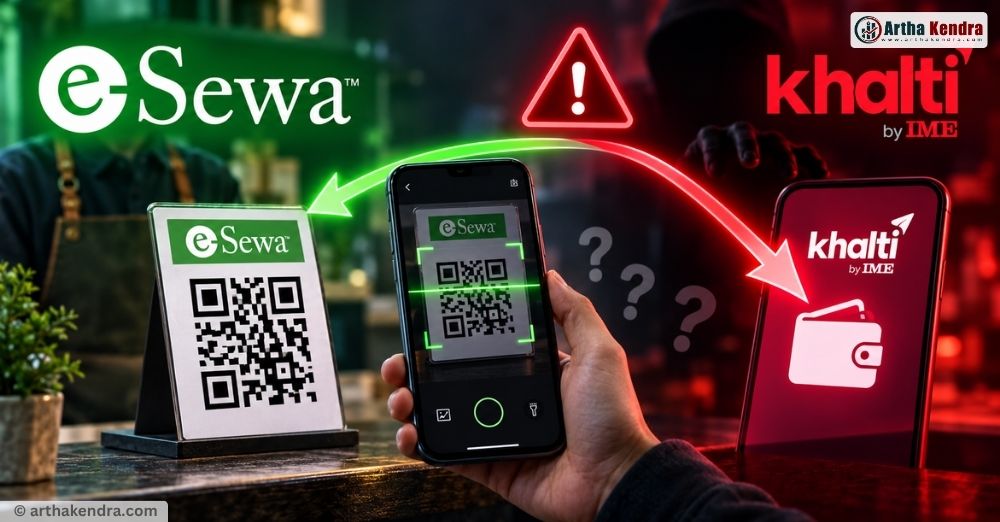
Khalti's Mischief: Scanning eSewa QR Sent Money to Khalti Account, Customer Forced to Pay Twice
An incident has surfaced where a customer scanning an eSewa QR code at a shop and paying via Khalti had the amount credited to the Khalti account linked to the same mobile number instead of eSewa. This raises questions about insufficient customer information in digital payments and the hassle of double payment.
Kathmandu. An incident has come to light where a customer, after scanning an eSewa QR code at a shop and paying through Khalti, had the amount go to the Khalti account linked to the same mobile number instead of eSewa, causing unnecessary hassle for the customer.
According to a customer, after having tea at a shop, he scanned the QR code provided by the shopkeeper and made the payment via Khalti. The transaction appeared successful on Khalti, and he even received a statement showing the amount deducted from his account.
However, the shopkeeper, upon checking the eSewa statement, said he had not received the amount. Only after some time, upon identifying the mobile number in the QR code, it was discovered that Khalti had sent the amount to the Khalti account linked to that same number, according to the customer.
In other words, when scanning an eSewa QR code, Khalti did not send the money to the eSewa account. Based on the mobile number mentioned in the QR code, the amount was sent to the Khalti account of the same number. But the shopkeeper, looking at his eSewa account statement, thought the amount had not been received.
Since the customer did not immediately know whether the shopkeeper had a Khalti account or not, ultimately the customer had to pay again via eSewa. Thus, it has been complained that a situation was created where the customer had to pay twice for a single cup of tea.
Earlier 'QR Not Supported', Now Money Goes to Another Account
According to the customer, previously when trying to pay by scanning an eSewa QR code from Khalti, a message saying "QR Not Supported" used to appear. In such a case, the customer could understand that the QR belonged to another payment system.
But now, without giving such a clear warning, when scanning the QR code, Khalti appears to send money to the Khalti account of the same number based on the mobile number in the QR code, the customer has questioned.
Even more interesting, the customer claims that when scanning Khalti's QR code from eSewa, a message saying "QR Not Supported" appears and the money cannot be sent.
This raises the question of whether customers are given sufficient information and clarity before a transaction in the QR payment system. Especially, if the QR belongs to another payment service, but after scanning, it is not clearly shown to the customer which account the money will go to, such incidents can confuse both customers and merchants.
The purpose of digital payment is to make transactions easy and fast. But if after scanning a QR code and deducting money, the merchant says they did not receive the amount, and ultimately the customer has to pay again through another medium, it appears to add unnecessary hassle for consumers.
On this matter, Khalti needs to clarify why it did not give clear information or warning to the customer before the transaction that when scanning another payment service's QR code, the money would be sent to the Khalti account based on the mobile number in the QR code.