
Idol Business Hit Hard by Floods, Landslides, and Recession; Traders Say 'This Time Even the Principal Won't Be Recovered'
In Bharatpur, Chitwan, a family making idols for Vishwakarma Puja has complained of poor sales this season due to floods, landslides, and the economic downturn. Out of 60-70 idols prepared with an investment of Rs 200,000, only 20-25 have been booked so far.
Kathmandu – Along the East-West Highway in Bharatpur, Chitwan, near Paras Bus Park, the noise of vehicles and the bustle of people are intense. Vishwakarma Puja is celebrated with great fanfare in workshops, garages, and factories. However, at the 'Bishal Murti Store' operating in a rented temporary space by the roadside, a different scene unfolds.
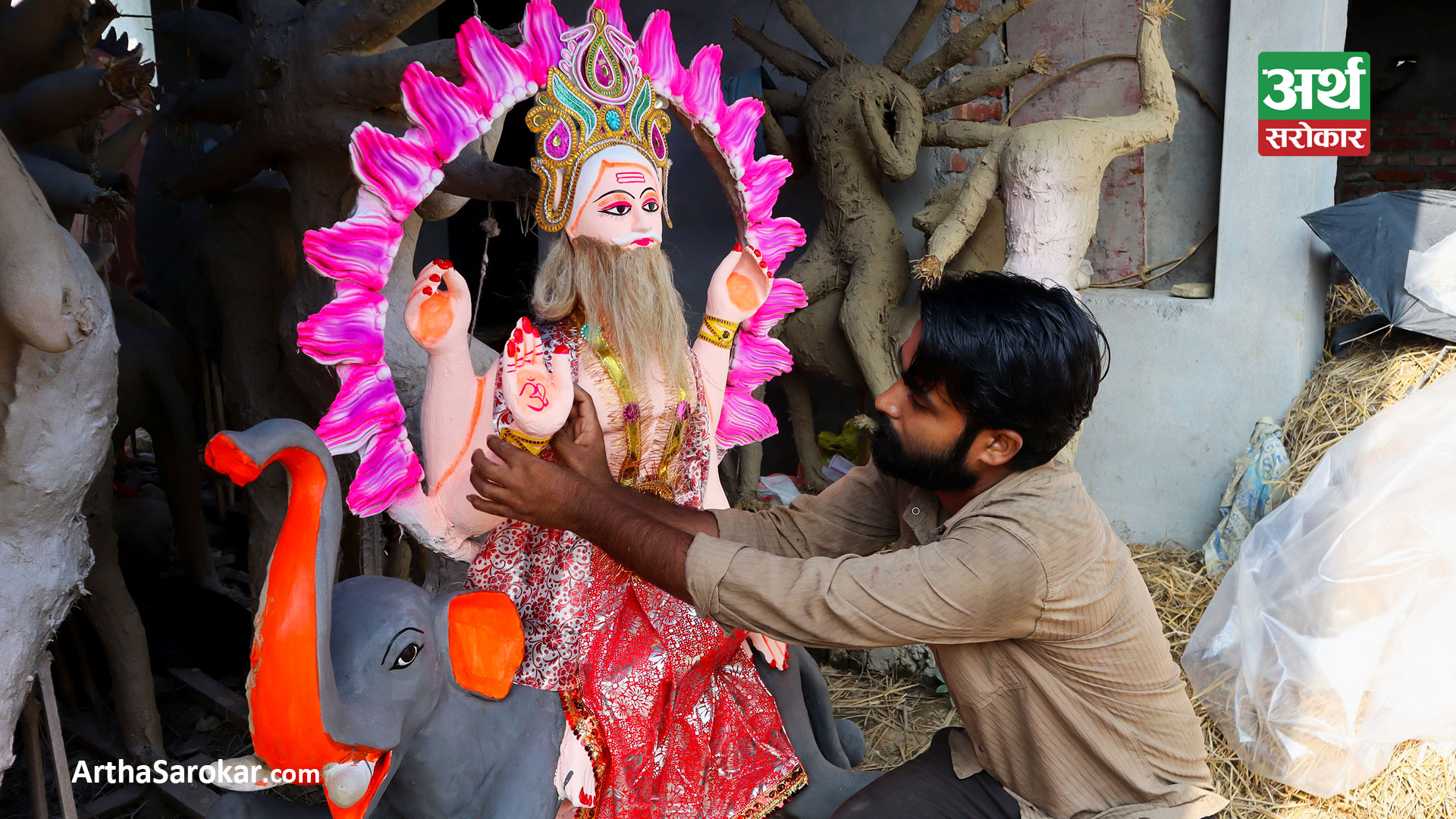
Family members are engrossed in painting and decorating the attractive idols of Vishwakarma Baba to give them final touches. At first glance, the colorful idols look neat and beautiful, but the faces of the artisans who shape them with their own sweat lack any real joy or enthusiasm.
Rajesh Pandit, whose ancestral home is in Sakuwa Dhomora of Rautahat and who has been making idols in various parts of the Terai, has been doing this work in Bharatpur for the past 18 years. For Rajesh, born into the Kumal caste, kneading clay and making idols is not just a business but also ancestral religion, tradition, and caste identity.
Rajesh, who has been engaged in this art for the past 30 years, supports about 10 family members from two generations who are fully dependent on this profession. Currently in Bharatpur, 4 members – Rajesh, his wife Nirmala Kumari Pandit, and their two sons – are working day and night.
2 Months of Sweat, Rs 200,000 Investment, and Rs 25,000 Rent
Making an idol requires more than ordinary effort. The process of bringing clay, wood, and straw to prepare a frame, shaping it, drying it, and finally painting it is quite complex. It takes a whole day just to bring one idol to the frame stage, while preparing, drying, and painting a group of 4-5 idols requires 4 to 5 days of intense concentration and hard work.
The Pandit family has been working continuously for the past 2 months to prepare 60 to 70 idols for this season. According to Nirmala Kumari, more than Rs 200,000 has already been invested in these idols, made from raw materials and decorations imported from India after paying customs. Additionally, Rs 25,000 per month must be paid for rent of the place and room.
Last year, business was affected by the Gen-Z movement in the country, and this time, due to floods, landslides, and disasters, people are in mourning and grief, which has dampened the festive spirit. 'Last year the government (movement) ate it, this year the floods ate it. There is no sign of even recovering the investment,' she says in a tired voice. Mainly garage, factory, and vehicle owners take these idols for Vishwakarma Puja. Depending on size, one idol costs Rs 3,000, Rs 3,500 to Rs 5,000. However, even on the eve of the puja, out of 60-70 idols, only 20 to 25 have been booked with difficulty.
More than 40 unsold idols now must be stored for next year by renting another room. 'Forget about profit, the situation is such that even the principal investment won't be recovered,' Nirmala Kumari expressed despair. Rajesh Pandit had also passed on this art, learned by watching his forefathers, to his 28-year-old son Nitesh Kumar Pandit. Nitesh, who started kneading clay and making idols with his father from the age of 15, used to be very happy doing ancestral work. But after business continuously declined over the past two years and it became difficult to support the family, he has become disillusioned. 'It is no longer possible to survive in this profession,' Nitesh said with a heavy heart, 'There is no work in Nepal now; all the youth have gone abroad. If things continue like this, I too will have no choice but to go abroad.'