
Huge Gap Between FDI Approval and Actual Inflow, Immediate Investment Needed to Revive Economy
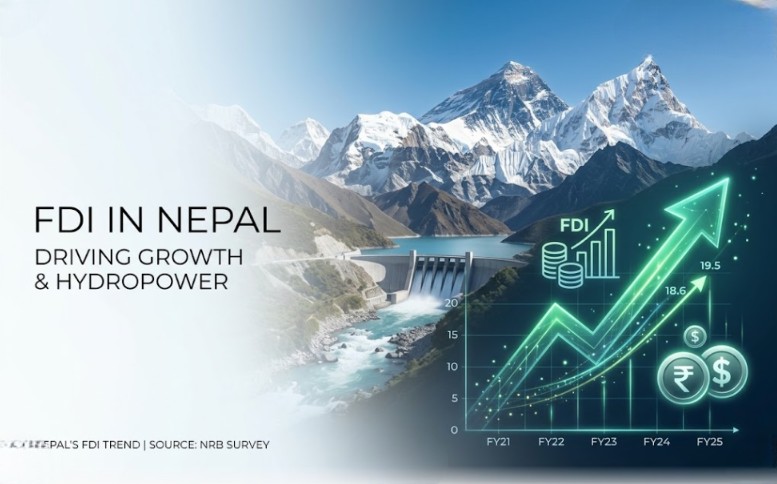
Although **NPR 577 billion** in foreign direct investment has been approved in Nepal, only **29.6 percent** has actually been realized. In FY 2081/82, the inflow was merely **11 percent** of the commitment, highlighting the need for structural and policy reforms.
Kathmandu. Although foreign direct investment (FDI) is critically needed to stimulate Nepal's economy, which is reeling from economic slowdown and inflation, the actual inflow of investment into Nepal remains disappointing.
According to data from Nepal Rastra Bank and CARE Ratings Nepal, there is a huge gap between the investment commitments approved by the government and the actual investment that materializes.
From 2053 BS to the end of FY 2081/82, a total of 931 projects have been approved for foreign direct investment amounting to NPR 577 billion through the Department of Industry and the Investment Board Nepal. However, only NPR 180.90 billion, or 29.6 percent, has actually entered Nepal. In FY 2081/82, the amount of investment inflow compared to the FDI commitment was merely 11 percent. This amount is significantly lower than the long-term average.
By the end of FY 2081/82, Nepal's foreign direct investment reached NPR 339.85 billion. This was 2.1 percent higher than the previous year. The amount of foreign investment inflow was NPR 12 billion. However, in that year, foreign companies took out NPR 4.70 billion as dividends. Looking at the difference between the outflow and inflow, the net inflow appears to be limited to NPR 7.30 billion. In the previous fiscal year 2080/81, net foreign investment was NPR 8.40 billion.
In Nepal's foreign direct investment, India has the largest share at 32.8 percent, while China accounts for 9.3 percent. Sector-wise, foreign investment is concentrated in energy at 27.8 percent, manufacturing at 27.8 percent, and the financial sector at 26.3 percent.
Various structural and policy issues are responsible for the failure of investment agreements or approvals in Nepal to translate into actual investment. Frequent changes in government and policies create uncertainty among foreign investors regarding long-term security.
Although project approval is easy, obtaining land, conducting environmental impact assessments, and securing local authority permissions can take years. Investors complain that the process of foreign currency payments or repatriating dividends through Nepal Rastra Bank is procedurally cumbersome.
More than 875 projects approved for foreign investment are small in nature, below NPR 150 million. However, large infrastructure and hydropower projects are delayed during the implementation phase.
Currently, Nepal's economy is passing through a slowdown, causing the general public to suffer from high inflation and rising prices. In such a situation, immediate foreign investment is necessary to increase liquidity in the market, create employment opportunities, and boost production capacity to control inflation. Only by immediately converting the NPR 577 billion commitment already approved on paper into action can the economy gain momentum and provide relief to citizens.