
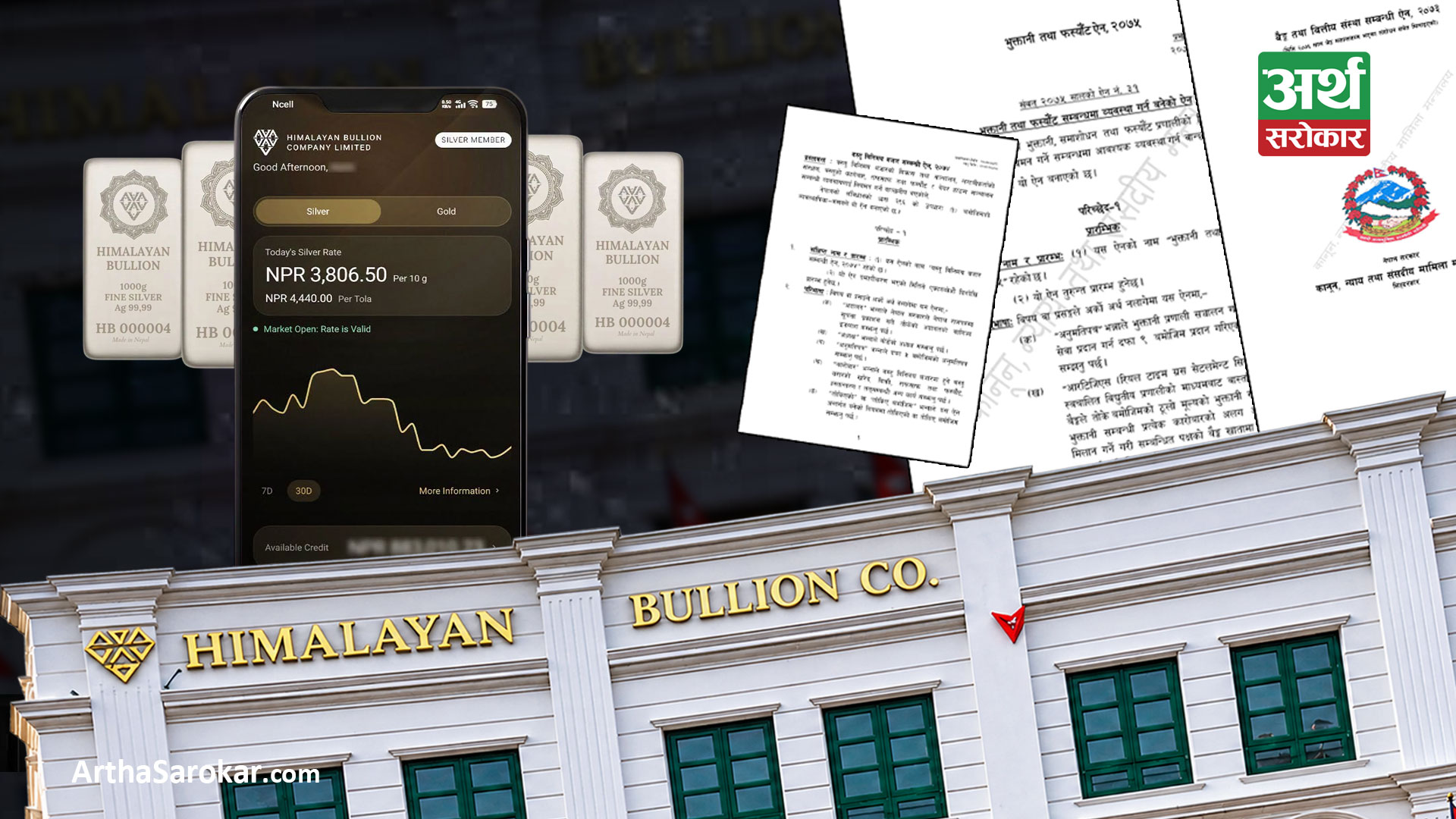
Himalayan Bullion's HBC App: Gold and Silver Trading Under Legal Scrutiny
The gold and silver trading conducted through Himalayan Bullion Company's HBC mobile app appears illegal under existing Nepali law. Nepal Rastra Bank, the Securities Board, and the Gold and Silver Dealers' Association have clarified that no app has been authorized for such transactions. The company, however, continues its operations by exploiting legal loopholes, putting consumer investments at risk.
Kathmandu — Some time ago, Himalayan Bullion Company launched the HBC mobile app with Minister Biraj Bhakta Shrestha in attendance. The company immediately advertised installment-based silver purchases on various social media platforms. However, what many do not know is that Nepali law does not recognize transactions conducted through such apps.
According to Section 3 of the Unified Directive 2082 issued by Nepal Rastra Bank, only Class A banks recommended by the Nepal Bankers' Association are permitted to import gold into Nepal. Section 4 of the same directive specifies how much gold can be imported and in what quantities it can be acquired. The directive also clearly states to whom and how much gold commercial banks may sell. In other words, only commercial banks have the authority to import gold and sell it to designated businesses. No mobile app outside this directive is permitted to sell or distribute gold and silver.
Another legal document, Section 3 of the Commodity Exchange Market Act 2074, prohibits commodity trading without a license. Gold trading is clearly commodity trading. This license is issued by the Securities Board of Nepal, and the law explicitly states that gold transactions are regulated under these rules. Although the Act came into force in 2074, no one has obtained a license for such trading to date. Himalayan Bullion is conducting business without obtaining the required license.
The Payment and Settlement Act 2075 clearly states that payment services cannot be operated without authorization. Such authorization is granted by Nepal Rastra Bank, which Himalayan Bullion has not obtained.
Sections 31 and 34 of the Bank and Financial Institutions Act 2073 clarify that no entity other than licensed banks and financial institutions may conduct banking and financial transactions. Section 49, Subsection (f) of the same Act specifies that the buying and selling of gold and silver is the exclusive domain of commercial banks. Sections 103 and 104 explicitly outline the penalties for conducting such activities without Nepal Rastra Bank's approval.
Now, regarding Himalayan Bullion Company: it claims to have obtained approval from Nepal Rastra Bank. However, Nepal Rastra Bank states that it has not granted any approval to any company for buying or selling gold. The Securities Board of Nepal has also stated that it has not permitted anyone to conduct such activities. The Gold and Silver Dealers' Association itself has clarified that digital gold trading is illegal.
Are all of Himalayan Bullion's transactions illegal then? Not necessarily. The gold and silver that Himalayan Bullion sells physically is lawful. Although many consumers have gone to court alleging fraud—which we will examine in another issue—the silver trading conducted through the mobile app is completely illegal.
By exploiting legal loopholes, Himalayan Bullion's activities attract offenses under the Bank and Financial Institutions Act and other laws. Yet the company continues its operations through misinterpretation of the law. Through the 'HBC' app launched in Ashoj 2083, Himalayan Bullion offers deals allowing silver purchases via the app. The company claims that after completing a 'Silver Target' through the app, customers can collect the silver they have secured. But questions remain: who regulates this, where is the silver stored, and who will be responsible if the company flees tomorrow? The answer is clear—if the company flees tomorrow, no one will take responsibility, and the silver claimed to be held by the company may not even exist.
Let us reiterate: in Nepal, no one other than commercial banks may import gold from abroad. Section 12 of the 'Gold Import and Sale Distribution Procedure, 2068' stipulates that banks may sell imported gold only to businesses registered with the relevant government authority, holding a permanent account number, and affiliated with an authorized association/organization of traders permitted to trade in gold. Selling gold and silver through any app other than a commercial bank or authorized dealer is completely prohibited. Similarly, Section 3 of the 'Commodity Exchange Market Act, 2074' clearly prohibits operating a commodity exchange market without a license.