
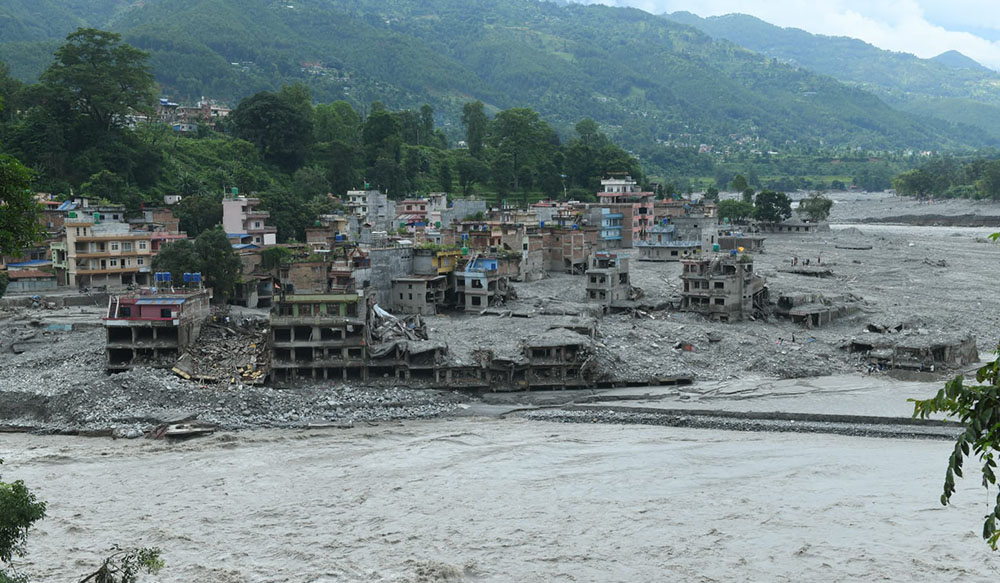
Government Moves to Name Bhote Koshi Flood, Forms Scientific Committee
The Ministry of Energy, Water Resources and Irrigation has formed a seven-member committee led by water policy and governance expert Devesh Belbase to scientifically study and name the devastating flood in the Bhote Koshi River in Rasuwa. The committee will conduct field studies from the flood's origin to the coastal areas and analyze it as a cascading disaster, including the potential role of climate change.
Kathmandu. The government has initiated a scientific study to name the devastating flood in the Bhote Koshi River in Rasuwa. The Ministry of Energy, Water Resources and Irrigation has formed a scientific committee to name the flood, which will collect scientific evidence and data on the Bhote Koshi flood and finalize an appropriate name.
In a preliminary study conducted by the Secretariat of the Water and Energy Commission under the Ministry of Energy, various names have come up for discussion. According to Tika Baral, Joint Secretary at the Secretariat, the names discussed include Glacier Rock Avalanche, Ice Rock Avalanche/Landslide, and Rasuwa Bhote Koshi Mega Disaster, among others.
"This is a rare event globally. Without a detailed study, we cannot reach a conclusion. The appropriate naming will be done after collecting all scientific evidence and data of this climate disaster," Baral said.
On Wednesday, the Ministry formed a seven-member committee led by water policy and governance expert Devesh Belbase to collect scientific evidence and data. According to Ministry spokesperson Mohan Kumar Shrestha, the committee includes the following experts as members:
- Hydrologist Dr. Narendra Man Shrestha
- Glaciologist Dr. Rijan Bhakta Kayastha
- Remote Sensing Expert Dr. Uttam Babu Shrestha
- Geologist Dr. Megh Raj Dhital
- Hydropower Infrastructure Expert Dr. Hari Pandit
- Disaster Risk Reduction Expert Anil Pokharel
The Ministry stated that the committee will conduct field studies from the flood's origin to the entire coastal area. The Ministry is undertaking a scientific study on the actual cause of the devastating flood and associated Himalayan geo-hazards, the sequence of events, and the potential role of climate change.
According to spokesperson Shrestha, the Ministry decided to conduct the scientific study based on the proposal of the Secretariat of the Water and Energy Commission to study the Rasuwa devastating flood not merely as a normal flood or heavy rainfall, but as a potential 'cascading disaster' that developed from various geographical, glacial, hydrological, and other hazards originating in the high Himalayan region, linked one after another.
Previously, the Hydrology and Water Resources Research Center under the Secretariat of the Water and Energy Commission conducted a preliminary study. The preliminary study found insufficient scientifically verified evidence on where the Rasuwa event originated, which physical process initiated the disaster, and how these processes spread through the Bhote Koshi–Lhende river system to the lower areas. Therefore, the Center suggested that a scientific study of the entire event sequence is necessary before concluding climate change as the cause.
Now, a comprehensive study of geology, temperature, and water is being undertaken. Spokesperson Shrestha said the Ministry took this initiative because, just as the Bhote Koshi flood affected the Trishuli Corridor, similar disasters in other river systems would directly impact various infrastructures of the Ministry of Energy. According to him, the study will also cover how to prepare long-term measures by learning from the damage to energy infrastructure caused by the Rasuwa flood, and how to maintain hydropower resilience (the capacity to withstand climate change, floods, droughts, or other natural disasters and continue generating electricity even in crisis situations).