
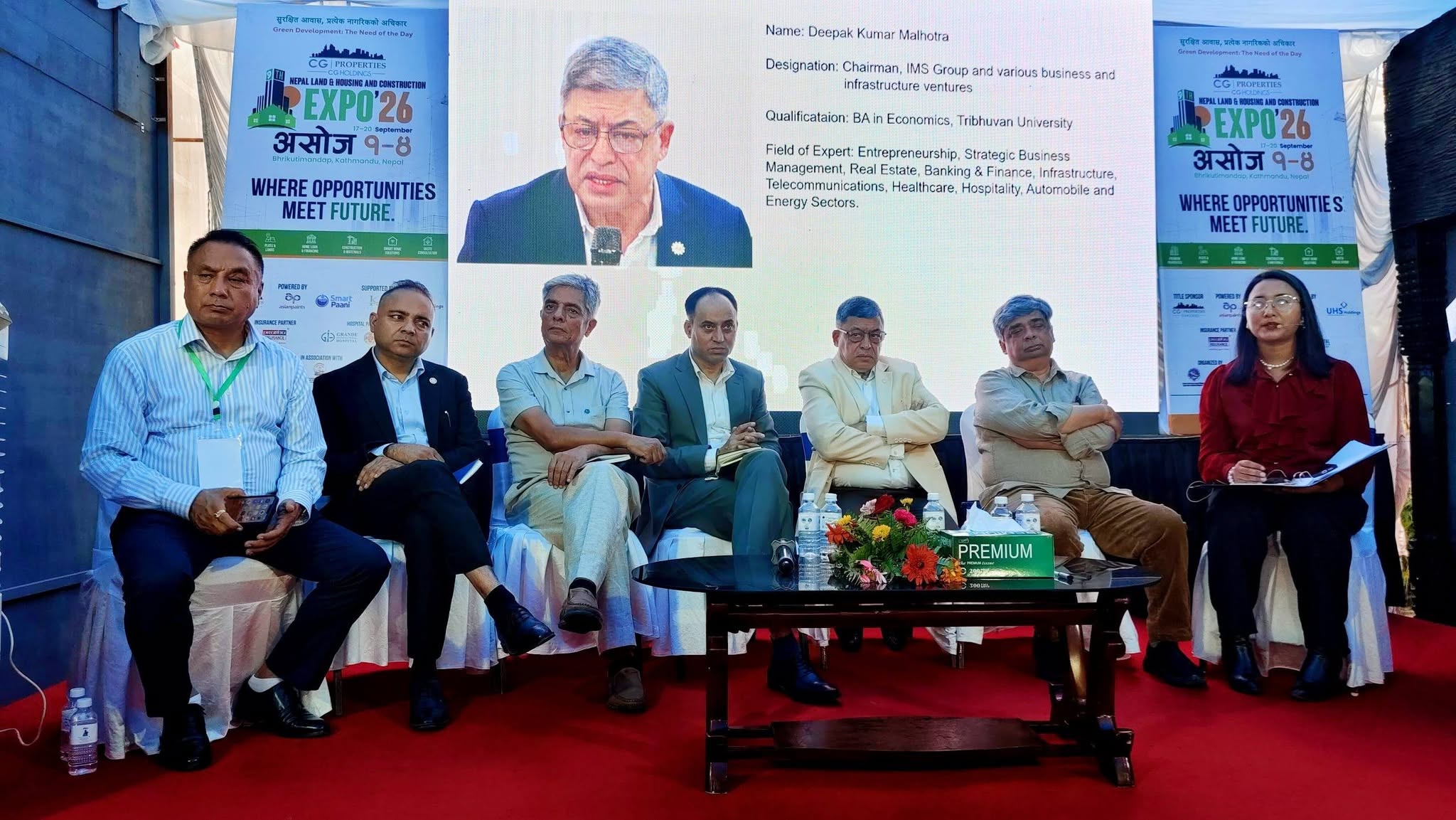
Emphasis on Public-Private Partnership and Integrated Housing Development in Post-Disaster Reconstruction
Stakeholders have stressed the need to advance integrated housing development through public-private partnership (PPP) for sustainable post-disaster reconstruction. At a panel discussion under the 'Nepal Land, Housing and Construction Expo-2083' held in Kathmandu, speakers said disaster risk reduction must be linked with housing and urban development planning.
Kathmandu. Stakeholders have emphasized the need to advance integrated housing development through public-private partnership (PPP) for sustainable post-disaster reconstruction and rehabilitation.
At a panel discussion held on Saturday under the 'Nepal Land, Housing and Construction Expo-2083' at Bhrikutimandap, Kathmandu, organized by the Nepal Land and Housing Development Association and Nepal Land and Housing Development Federation, and co-organized by the Nepal Chamber of Commerce on the occasion of its 75th Diamond Jubilee, speakers said disaster risk reduction must be linked with housing and urban development planning.
At the discussion, Deputy Development Commissioner of the Kathmandu Valley Development Authority, Prakash Aryal, said risk must be identified before construction to minimize human and physical losses from disasters. He said the risk communication and preparedness system must be made effective, and the building construction permit system must be linked with the overall construction process.
He said a comprehensive integrated policy is needed to manage settlement development in river corridors and high-risk areas. He argued that if risk, the population at risk, and the status of assets are linked with housing plans and investment, damage from disasters can be reduced.
Aryal said that although laws and building codes related to building construction exist, effective implementation still remains a challenge. Noting that practices such as the electronic building permit system are progressing in local levels, he pointed out the need to revise the building code in a timely manner, keeping seismic risk in mind. He argued that integrated monitoring, early warning systems, and risk-sensitive planning must be linked with the construction system to protect against natural disasters like the Rasuwa flood.
Senior Vice President of the Nepal Chamber of Commerce, Deepak Kumar Malhotra, said business-friendly policies are needed for the housing and real estate sector. He said that since the government formulates policies and the private sector makes investments and advances development accordingly, effective collaboration between both sides is necessary.
He said that in Nepal, due to the lack of practical policy and legal arrangements regarding the sale of apartments to foreigners and the transfer of ownership of common areas in joint and collective housing, the matter has not yet been fully systematized. He noted that although some issues were addressed through the budget, the necessary policies have not yet been fully implemented. He suggested that the government and private sector should collaborate to build 'affordable housing' targeting the middle class and flood victims.
Malhotra noted that about 240 industries and businesses are directly and indirectly linked to the real estate sector, and activities in this sector positively impact everything from construction materials to the financial and service sectors. He emphasized that housing development work should be advanced through the public-private partnership model in all seven provinces of Nepal. 'The tendency to view everyone investing in real estate as land traders must change,' he said. 'Since the economy runs on investment, a positive environment must be created for investment in the housing and infrastructure sector.'
Architect Nabin Devkota of the Society of Nepalese Architects (SONA) said that in Nepal, the main problem is not the lack of policies and laws related to housing and land development, but rather weaknesses in implementation and strategy. He stated that standards-based housing development is necessary in Nepal, as in developed countries, and that conflicts between various policies and regulations are creating problems.
He said that uniform implementation of the building code across the country has not been possible, monitoring is weak, and wrong practices in engineering approval must be controlled. Emphasizing that the role of expertise in the building construction permit process must be institutionalized, he held the view that local levels should not view building construction merely as a source of revenue.
Director of the Kathmandu Institute, Architect Biresh Shah, said urban development should not be viewed from a single perspective. According to him, urban development requires coordination among various subjects including economics, community, culture, environment, geography, sociology, and architecture.
He said the planned urban development practice that began in Nepal about 60 years ago must be revised according to the times. He stated that the tendency to consider road and physical infrastructure construction alone as the basis of urban development must be abandoned.