
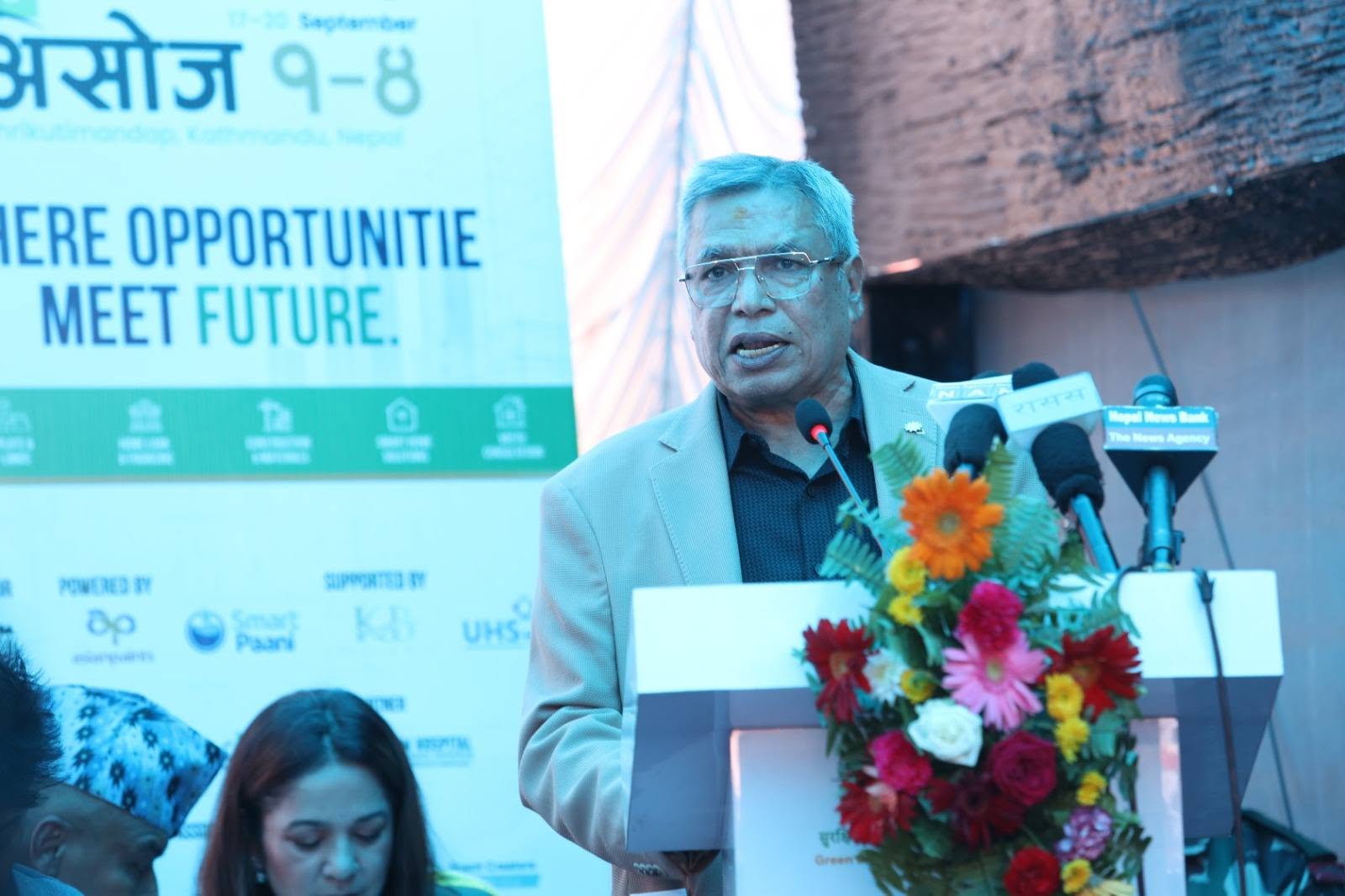
Economic Slowdown Cannot End Without Real Estate Revival: President Agrawal
President of Nepal Chamber of Commerce, Kamlesh Kumar Agrawal, stated that the economic slowdown cannot be ended without reviving the real estate sector. He emphasized how high interest rates, tight lending policies, and falling property prices have affected entrepreneurs and businesses, and suggested policy reforms.
Kathmandu. President of Nepal Chamber of Commerce, Kamlesh Kumar Agrawal, has said that the end of Nepal's economic slowdown is impossible without reviving the real estate sector.
Speaking at the inauguration ceremony of the 9th Land, Housing and Construction Expo–2026, President Agrawal noted that the land, housing, and construction sector is a vital foundation of Nepal's economy. He mentioned that this sector directly impacts employment generation, investment mobilization, banking and financial sector activities, construction material industries, revenue, and overall economic activities.
Recalling that the land, housing, and construction sector was expanding rapidly before the COVID-19 pandemic, President Agrawal said that in recent times, the real estate sector has been affected by the pandemic, global geopolitical and economic challenges, and restrictive policy arrangements. Its impact has been felt from the loan portfolios of banks and financial institutions to industrial and commercial activities.
President Agrawal stated that due to high interest rates and tightness in credit flow, many entrepreneurs and businesses have faced difficulties in paying installments and interest to banks and financial institutions. He noted that a large number of entrepreneurs and businesses have been blacklisted, and in some cases, mortgaged land and properties have reached the banking auction process. The decline in property prices has weakened the investment capacity of the private sector, and the perception of risk among businesses to start new projects has increased, he said.
To revitalize the real estate sector, President Agrawal suggested the following policy reforms:
- Rescheduling and restructuring of housing and real estate loans
- Reviewing policy arrangements related to loan risk weights and valuation to increase necessary liquidity and access to capital in the market
- Reviewing strict provisions related to debt-to-income ratio in land and property purchases
- Effectively implementing the provision to lease 25 percent of apartments to foreigners
- Removing ambiguities in land use policy and implementation
- Ending administrative complexities in plot subdivision and land classification
- Ensuring effective coordination among local levels, land revenue offices, and survey offices
- Prioritizing the development of digital land records and an integrated land information system
- Reviewing taxes and fees including registration fees and capital gains tax, and reducing fees and procedural costs levied at various levels on the same property
President Agrawal said that although real estate companies operate businesses by purchasing land, developing, constructing houses, and apartments, and selling them, the provisions related to land ceiling have created obstacles in the development of this sector, and the policy knot must be untied.
He emphasized the need to formulate a comprehensive real estate policy by coordinating among Nepal Rastra Bank, the Ministry of Finance, the Ministry of Land Management, local levels, and the private sector. He believes that the revival of the real estate sector will have a positive impact on economic activities, investment, and employment expansion.
Wishing success for the 9th Land, Housing and Construction Expo 2026, President Agrawal expressed confidence that the expo will become an important platform for cooperation and dialogue among stakeholders in the land, housing, and construction sector.