
Dashain Under Inflation's Grip: A Costly Festival
Although Dashain shopping has begun in the markets of the Kathmandu Valley, consumers are struggling with rising prices of food grains, clothing, and meat products. With the Rasuwa and Tatopani border points with China blocked, goods worth about Rs 5 billion have been stuck, while the government has intensified market monitoring.
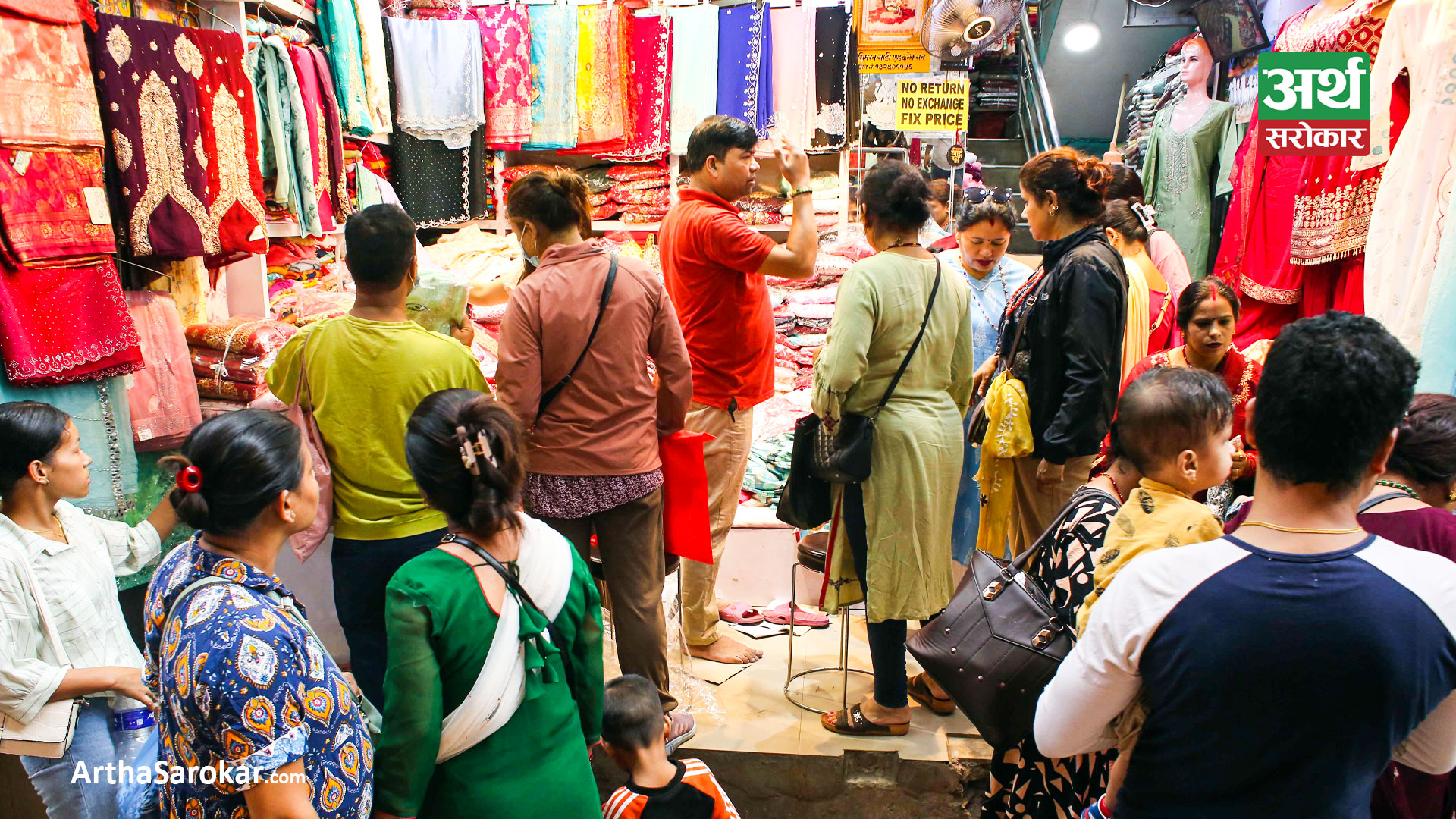
Almost all major markets within the Kathmandu Valley are currently crowded with shoppers. As Dashain approaches, there is heavy footfall of people buying clothes and essential goods in areas including Bhotahiti, Thamel, Asan, Indrachowk, Jamal, Bishal Bazaar, Sundhara, Khichapokhari, New Road, Bagh Bazaar, Dillibazar, Baneshwor, and Putali Sadak.
After the Bhotekoshi flood on Bhadra 10, two border points with neighboring China have been closed, leading consumers to speculate that prices, especially of clothing, may have risen somewhat compared to last year. Consumers also complain that the prices of daily consumables and food grains have increased significantly in recent times.
Shalikchandra Sharma of Kathmandu Metropolitan City-32 says that with rising inflation, celebrating the festival has become difficult.
‘The price of fine jira rice has increased by Rs 300 per sack,’ he said. ‘The price of goat meat, which is essential during Dashain, has also increased by three to 400 per kilogram. For those with low income, celebrating Dashain seems difficult.’
Not only Shalikchandra, but Smita Khatri of Tinkune is also thinking of giving her family members a new pair of clothes this Dashain. However, despite the rise in clothing prices, she said she has somehow managed to buy new clothes for her three children.
‘During Dashain, one must at least give a set of clothes,’ she said. ‘For those with limited income, Dashain becomes like a curse; what to do, one cannot avoid celebrating.’
Consumers say that for those with low income sources, celebrating Dashain has become a great ordeal. Madhav Timilsina, president of the Consumer Rights Research Forum, says that this Dashain, the prices of food grains, clothing, and other essential goods have increased significantly.
‘Prices of all kinds of food grains have increased in the market,’ he said. ‘Now the prices of fresh vegetables, fruits, and meat products have skyrocketed.’
President Timilsina says that the government's concerned agencies must regularly monitor the market and move forward to control price hikes.
‘The government must regularize the supply chain and intervene to control price increases,’ he said.
Ramchandra Parajuli, general secretary of the Nepal Himalayan Trans-Himalayan Commerce Association, says that with the Rasuwa and Tatopani border points—the main lifelines connecting to neighboring China—blocked, bringing goods and materials has become difficult.
‘The blockade of border points with China has also had a big impact on trade,’ he said. ‘Goods worth about Rs five billion aimed at bringing from China for Dashain and other festivals are stuck at the border.’
Similarly, Ritesh Kumar Shakya, director general of the Department of Commerce, Supplies and Consumer Protection, says the department has been intensifying festival-targeted monitoring.
‘Currently, we are monitoring 25 to 50 different firms and companies daily. We are also bringing traders and businesses that charge more than the maximum retail price under the necessary legal scope,’ he said.
Director General Shakya has requested everyone to sell goods and materials according to the designated prices.