
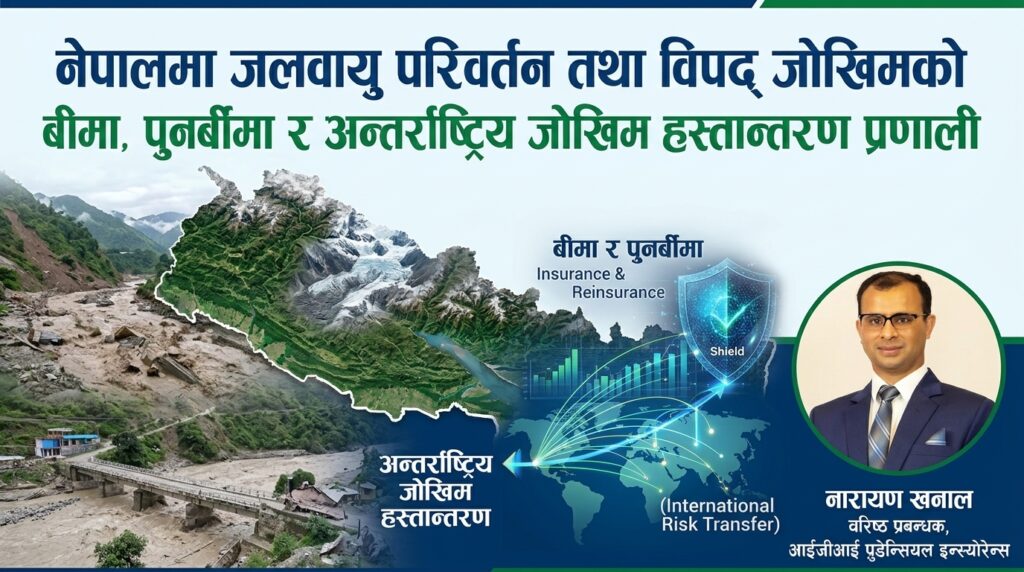
Climate Disaster Risk in Nepal: The Need for Insurance, Reinsurance and International Risk Transfer
Climate change is increasing disaster risks in Nepal such as floods, landslides and glacial lake outbursts, causing massive damage to infrastructure and the economy. Instead of the traditional practice of raising funds after a disaster, it is essential to develop a system of pre-arranged insurance, reinsurance and international risk transfer.
Introduction
Climate change, global temperature rise, glacial lake outbursts in the Himalayan region, excessive rainfall, floods, landslides, soil erosion, river cutting, earthquakes and other natural disaster events have emerged in recent times as serious challenges to human life, economic activity, infrastructure and national development. In a country like Nepal with geographical and climatic diversity, the impact of such disaster risks tends to be even more widespread and complex.
Different types of disaster risks exist across Nepal's Himalayan, hill and Terai geographical regions. In the Himalayan region, there is a high risk of glacial lake outbursts and avalanches; in the hill region, landslides, soil erosion, riverine floods and earthquakes; and in the Terai, inundation, river cutting and floods. Climate change is making the pattern, intensity and timing of rainfall abnormal, challenging even traditional risk management systems.
When such disasters occur, not only is there human loss, but also massive damage to roads, bridges, hydropower projects, transmission lines, airports, schools, hospitals, water supply systems, government buildings and private property. After a disaster, the government is forced to spend large sums on immediate relief, rescue, rehabilitation and reconstruction. Such expenditure is usually managed through the annual budget, domestic borrowing, foreign aid, budget reallocation or cuts to other development programs.
Since this traditional arrangement mobilizes financial resources only after a disaster occurs, it can adversely affect the state's economic stability, implementation of development projects and long-term investment.
Therefore, alongside physical measures to reduce disasters, it is essential to develop a system of pre-arranged insurance, reinsurance and international risk transfer for economic losses that may result from disasters. If the government can establish a system of identifying and assessing risks, paying pre-arranged premiums, and receiving claims under insurance contracts as soon as a disaster occurs, disaster management can be made more effective, transparent and financially sustainable.
The time has come for Nepal to move from the traditional practice of raising funds after a disaster toward a system that ensures financial security before a disaster occurs.
Nature and Economic Impact of Nepal's Disaster Risk
Nepal's disaster risk is not merely a natural event; it is a matter directly related to the economy, society, finance, environment and development. The country's geographical location, weak geological structure, unplanned construction, settlement expansion along riverbanks and landslide-prone areas, climate change and the nature of infrastructure development have further increased disaster risk.
Climate Change and New Types of Risk
Climate change can produce effects such as extreme rainfall occurring in a short period, prolonged drought, rising temperatures, melting glaciers and increasing size and risk of glacial lakes. These changes can cause sudden increases in water flow in river systems.
The risk of floods, landslides and river cutting in the Bhote Koshi, Sun Koshi, Melamchi, Kali Gandaki, Trishuli, Marsyangdi and other river systems cannot be considered merely a local problem. Such events can simultaneously damage many roads, bridges, hydropower projects, transmission lines, settlements and commercial activities.
Damage to Physical Infrastructure
In Nepal, hydropower projects, roads and bridges are mostly built along riverbanks, in mountain gorges, on steep land and in risky geographical areas. The risks to such infrastructure may include the following types of damage:
- Damage to dams, intakes, headworks, tunnels, penstocks and powerhouses of hydropower projects
- Sweeping away or collapse of bridges, roads and culverts built on rivers
- Weakening of road foundations and embankments due to river cutting
- Damage to power transmission lines, substations and distribution systems
- Damage from landslides to project sites, construction materials, equipment, machinery and worker camps
- Damage from floods to industrial areas, agricultural production, tourism, hotels and commercial establishments
- Disruption of services of schools, hospitals, government offices, water supply and sanitation structures
Financial Liability on the Government
When a disaster occurs, the government must spend large sums on relief, rescue, temporary shelter, food, health services, rehabilitation and reconstruction. If public structures are damaged, reconstruction can take years.
Due to disaster expenditure:
- The development budget may not be spent in other sectors
- Construction of new projects and upgrading of old projects may be affected