
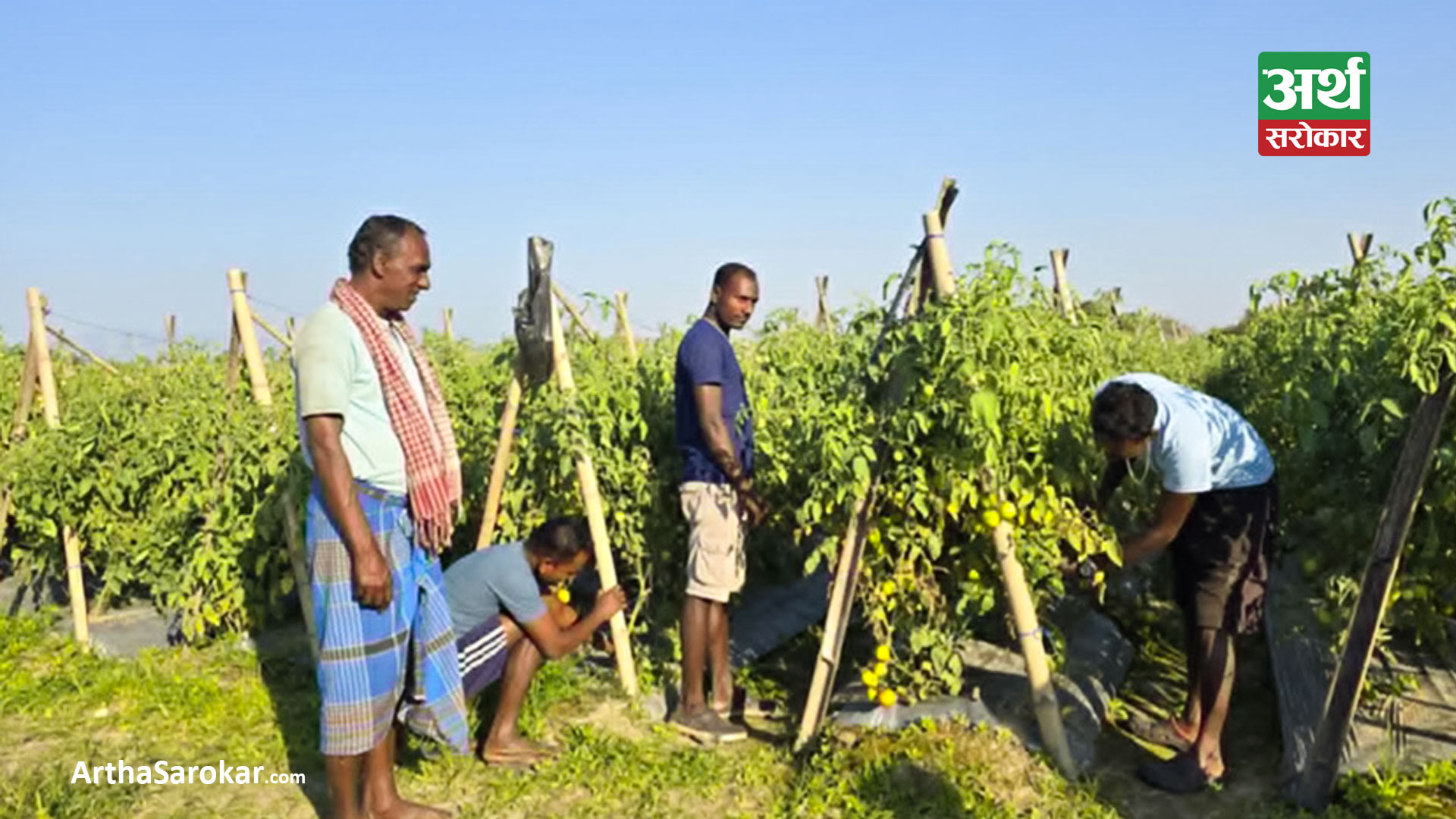
Chandravanshi family finds prosperity in agriculture, shunning foreign employment
Arjun Chandravanshi of Sri Lanka Tappu in Barahakshetra Municipality-9 has engaged his four sons in farming, earning up to Rs 6 million annually. By discouraging them from going abroad, he has made vegetable farming the family's main source of income.
Kathmandu — Arjun Chandravanshi of Sri Lanka Tappu in Barahakshetra Municipality-9 has engaged his four sons in agriculture. Having been involved in tomato and other vegetable farming for nearly two decades, he has made agriculture the family's main source of income.
His farm produces tomatoes, cabbage, and beans year-round. Arjun's four sons—Ramvilas, Laxman, Shriram, and Jadulal Chandravanshi—are dedicated to farming, following in their father's footsteps.
'My sons used to say they would go abroad; I gave them Rs 50,000 to stay in Nepal and did not let them go. Now, all my sons can earn millions staying here,' Arjun said.
He said he engaged all four sons in agriculture with the belief that one can earn well by working hard in Nepal rather than toiling abroad. Previously, there were no roads or transportation facilities. Produce from a few katthas had to be carried to the market on foot. Now traders come to the farm with vehicles.
The Chandravanshi family currently cultivates tomatoes on five bighas. They also grow seasonal vegetables on some land. During the main tomato season from Kartik-Mangsir to Falgun-Chaitra, more than 50 workers are employed on Arjun's farm. Even in the off-season, 25 wage workers are engaged in the field, Arjun informed.
Last year, due to good tomato prices and favorable weather, the business turnover was around Rs 10 million, he said. 'Let's see how it goes this year. Even if prices are not good, after deducting all expenses, we can easily earn up to Rs 6 million annually,' he said.
According to Arjun's son Shriram, tomato prices vary based on market demand and production. Normally, they sell for Rs 30 to 50 per kg, and sometimes up to Rs 80 to 95. Sometimes they have to sell at Rs 5 per kg, he said.
He said tomato prices are good from Mangsir to Baisakh. 'During good price periods, we sell tomatoes worth over Rs 300,000 in a single day,' Shriram said. 'Seasonal vegetables like beans, cucumbers, and cabbage are also sold according to the season.'
Arjun's second son Laxman returned to Nepal after staying in Malaysia for four years and now helps his father in farming. 'Earnings are better in Nepal than abroad. Farming is our ancestral occupation. Initially, we grew potatoes, cabbage, and other vegetables. Later, as tomato farming started yielding good income, we expanded it,' he said.
Laxman said they are doing commercial farming by learning from social media rather than formal training. 'We are doing commercial farming by watching social media,' he said. Of about 12 bighas of land, five bighas are used for tomato and other vegetable farming, he said. The remaining land is used for maize and paddy. 'There is no market problem for selling our tomatoes. We don't have to search for markets. Traders come to the farm themselves. When buying from here, we sell at a lower price than the market,' Laxman said.
Traders from Dhankuta, Dharan, Itahari, Gaighat, Rajbiraj, Jhapa, and other places come to the farm to buy tomatoes. He said investment in this farming is increasing, and it involves hard work. He said production is good relative to investment, and there are no losses.
'Now, this farming has provided employment to all family members and also allowed us to employ others,' he said. In Sri Lanka Tappu of Barahakshetra Municipality-6 and 9 alone, tomatoes are cultivated on about 300 bighas. Most farmers grow other seasonal and off-season vegetables along with tomatoes.
Prabin Lal Shrestha, information officer at the Agriculture Knowledge Center, Sunsari, said that currently, vegetables are cultivated on 8,153 hectares in Sunsari.
Mayor Ramesh Karki of Barahakshetra Municipality said that since the production of tomatoes, cabbage, beans, and other vegetables is good, most farmers here are engaged in commercial vegetable farming.
90 percent of the locals in Sri Lanka Tappu are focused on agriculture and vegetable production. Sri Lanka Tappu is a renowned area for vegetable farming. Mayor Karki informed that the municipality has been providing subsidies on fertilizers, seeds, and other materials to encourage local farmers to increase production.