
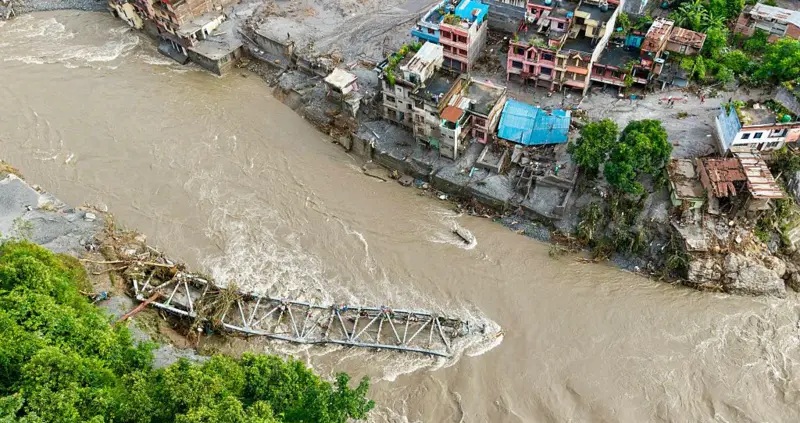
Bhotekoshi Flood Causes Over NPR 79 Billion in Damage, 26 Percent of Victims Want to Return to Original Location
The Bhotekoshi flood that struck the Nepal-China border area on Bhadra 10 has caused an initial estimated damage of NPR 79.17 billion. According to a survey by the National Planning Commission, 7,316 families and establishments were affected, with 3,067 families suffering complete house damage. Among the victims, 25.99 percent expressed a desire to return to their pre-flood location.
Kathmandu. The devastating flood that occurred on Bhadra 10 in the Bhotekoshi River along the Nepal-China border area has caused an initial estimated damage of NPR 79.17 billion. According to a press release issued by the National Planning Commission on Asoj 30, the flood caused damage of this magnitude to households and business establishments.
According to the Commission's survey results, the highest damage occurred to private homes. Property worth NPR 69.57 billion was destroyed in the household sector alone, while businesses and establishments suffered NPR 9.60 billion in damage. In addition, further damage occurred to land, farmland, food grains, livestock, vehicles, and valuable goods.
The Commission collected damage records by surveying 15 local units in Rasuwa, Nuwakot, Dhading, and Gorkha. According to the press release, a total of 7,316 families and establishments were affected by the flood and landslide, of which 6,817 were households and the rest were businesses and establishments. Among these, the highest number—4,164 families and establishments—were affected in Nuwakot.
According to the Commission, 32,872 people were directly affected by the flood. These include 16,714 males, 16,080 females, and 78 people of other genders or whose gender identity is not disclosed.
The flood damaged 4,151 building structures belonging to 3,067 homeowners. Of the damaged structures, 2,989, or 72.01 percent, were completely collapsed or swept away. An additional 508 building structures were buried in mud and silt. The Commission reported that 76.95 percent of structures are in a condition where they cannot be fully used from a reusability perspective.
Flood Victims' Desire for Rehabilitation and Resettlement
When asked about options for future permanent residence, the 3,067 families whose homes were completely damaged gave mixed responses.
- 30.62 percent (939 families) expressed a desire to stay in the same location if the government provides land.
- 25.99 percent (797 families) expressed a desire to return to their pre-flood location.
- 19.24 percent (590 families) said they are willing to stay if the government arranges collective housing.
- 18.42 percent (565 families) chose the option of residing on another plot of land they own within the district, and 5.18 percent (159 families) chose to reside on another plot they own elsewhere in the country.
Immediate Challenges to Restoring Normal Life
With approximately more than 3,194 buildings destroyed beyond reuse, the main challenge is to arrange safe temporary or permanent housing for those families, such as collective housing or alternative land management.
According to the Commission, with damage to more than 507.97 hectares of land and the destruction of stored food grains and crops, averting a food crisis and restoring the livelihoods of affected people is another major problem.
With total damage exceeding NPR 79.17 billion, the government faces a major test in securing adequate financial assistance from donor agencies in a timely manner, as large-scale financial resources are needed but domestic resources are limited.
If the reconstruction of flood-damaged road networks and washed-out concrete bridges is delayed due to a lack of adequate financial resources, this will cause further economic damage. Additionally, rapidly repairing and reconstructing retail trade, housing and food services, and other basic infrastructure to stimulate economic activity appears challenging.