
Bhote Koshi Flood: A Complex Mix of Factors Including Climate Change, Preliminary Conclusion of International Experts
The devastating Bhote Koshi flood of last Bhadra 10 was not caused by a single factor but by the interaction of complex factors including climate change, permafrost melting, and glacier shrinkage, according to the preliminary conclusion of international experts. According to an analysis by more than 20 scientists, this is an 'unprecedented disaster' in the Himalayas, in which human-induced climate change created the preconditions.
Kathmandu. International experts have conducted research on the devastating Bhote Koshi flood of last Bhadra 10 and have identified the preliminary cause of the flash flood. However, they are still investigating.
According to a new scientific analysis by more than 20 international experts, the devastating flood at the Nepal-China border is the result of a mix of complex factors, among which human-induced climate change has exacerbated the natural disaster.
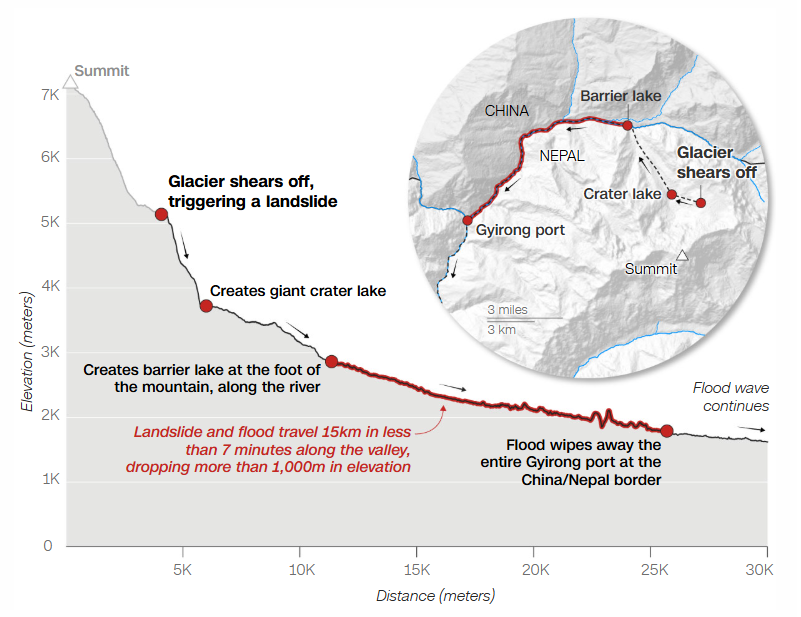
The area is still grappling with the impact of a devastating rock and ice avalanche that flowed through a narrow mountain valley, which destroyed towns, roads, and bridges. At least 1,300 people have died and more than 5,000 are missing.
As rescue efforts transition into recovery operations and the country begins a massive reconstruction effort, scientists around the world are trying to understand what caused this tragedy.
According to experts, on Bhadra 10, a massive chunk of rock and glacial ice about 2,000 feet wide broke off from Langtang Lirung mountain and fell about 7,000 feet down into the river. This released energy equivalent to a 5.2 magnitude earthquake. It fell so fast that the ice melted almost instantly. The flow also carried wet soil and debris and possibly collided with buried snow at the valley floor, making the flood surge even more powerful and traveling more than 20 miles.
Walter Immerzeel, a mountain hydrologist at Utrecht University in the Netherlands, said this was an 'unprecedented disaster' in the Himalayas.
The team of glaciologists and climate scientists from the World Weather Attribution (WWA) network, which investigates the role of climate change in extreme weather events, released its preliminary analysis report on Wednesday after investigating the incident. According to the report, the disaster was not caused by a single extreme weather event but by the interaction of many processes, as global temperatures have risen for decades due to fossil fuel pollution.
Scientists found that the 7.8 magnitude earthquake of 2072 BS may have weakened the slope by causing a rock and ice avalanche from the southern part of the mountain, leaving the mountain in a state prone to collapse. 'Since then, landslides on the mountain had been increasing,' the report said.
Scientists then looked at the role of climate change and found that many processes were operating simultaneously. Climate change is pushing the 'zero degree' line higher in the Himalayas. That point in the atmosphere where the temperature reaches 0 degrees Celsius (32 Fahrenheit) is rising by more than 320 feet per decade.
The report states that rising temperatures are weakening permafrost (a mixture of ice, rock, sand, and soil that can act as glue) in Nepal's high mountains, especially near the altitude where the incident occurred. Immerzeel said, 'Melting permafrost reduces the strength of rock and allows more water to flow down the slope.'
Glacier change is another important factor. The report notes that in recent decades, especially after 2010, the Langtang-Lirung glacier has significantly thinned and shrunk, making the slope less stable and allowing meltwater to seep into rock cracks.
Researchers also looked at the weather conditions before the incident. In the last autumn, in early October and November, there was heavy snowfall in the area. Then July and August were the hottest months on local record, producing a large amount of meltwater and further weakening the slopes.
Using historical data and climate models, researchers found that due to climate change, July and August temperatures in the area are now about 1.5 degrees Celsius (2.7 Fahrenheit) higher. The region's annual temperature has increased by 2 degrees Celsius (3.6 Fahrenheit), which is significantly higher than the global average.
The study did not find a clear link between global temperature rise and increased snowfall and rainfall. However, overall, Frederick Otto, a professor of climate science at Imperial College London, said, 'There is no doubt that human-induced climate change played a role in creating the preconditions for this disaster.'
Scientists concluded that this event was different from anything previously experienced in the region in terms of its size, speed, and complexity. 'None of the existing early warning systems provided adequate