
A decade of earthquakes, floods, pandemics, and political crises: Economic pressure mounts on Nepal's economy
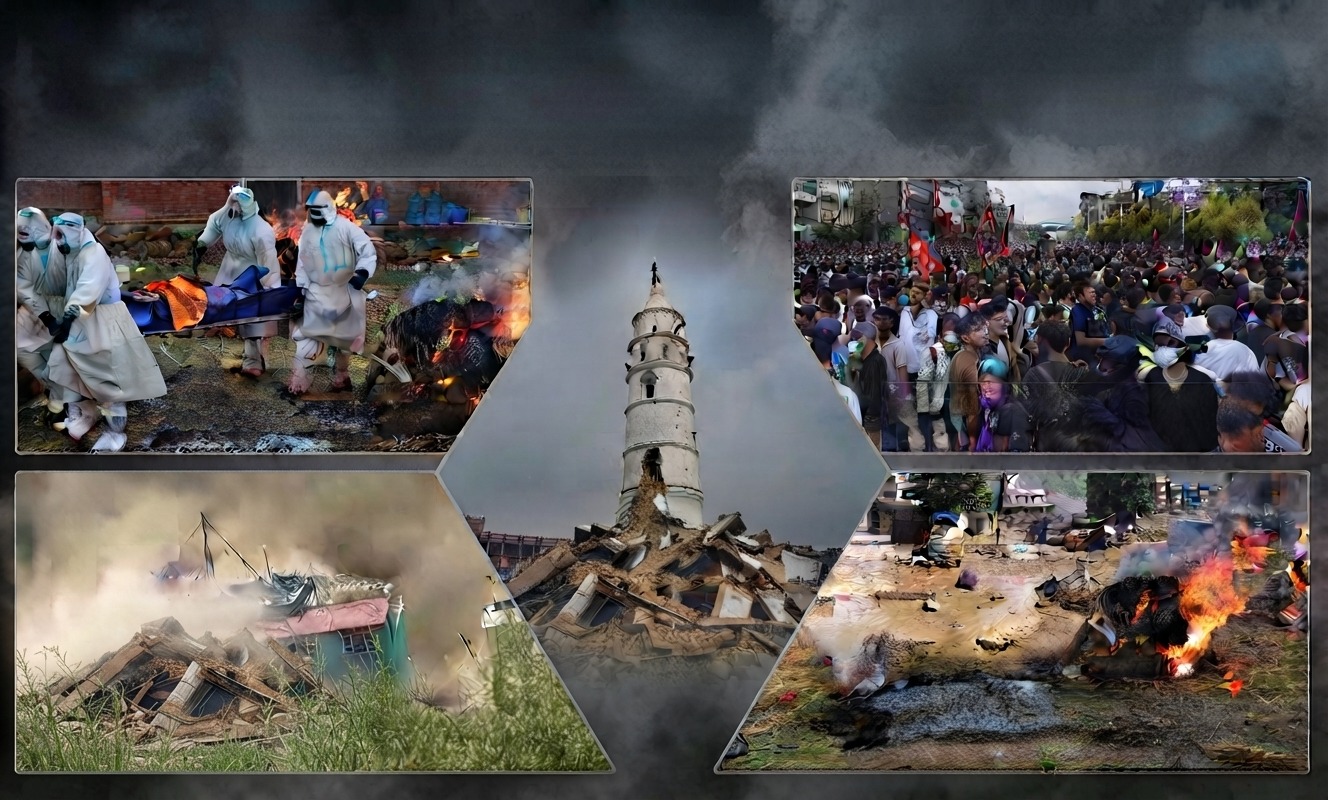
Over the past decade, Nepal has endured a series of shocks—earthquakes, floods and landslides, the COVID-19 pandemic, and political and international tensions. These have deeply affected production, employment, infrastructure, and agriculture, pushing public debt from NPR 627 billion to NPR 2.981 trillion.
The past decade has not been easy for Nepal's economy. At times a powerful earthquake, at times floods and landslides, at times a global pandemic, and at times political and international tensions repeatedly disrupted economic activity. Before the economy could recover from one crisis, another struck, diverting resources meant for development toward relief, rescue, reconstruction, and rehabilitation.
During this period, the damage was not limited to roads, bridges, hydropower projects, and homes. Industries and businesses shut down, production fell, jobs were lost, agriculture was affected, and many families fell back into poverty. As the government had to spend large sums to cope with the crises, pressure on public finances also increased.
One indication of this is the growing size of public debt. Government debt, which stood at NPR 627 billion in fiscal year 2072/73, reached NPR 2.981 trillion by 2082/83. Government studies show that post-earthquake reconstruction and spending during the COVID-19 pandemic, along with the loans taken for them, contributed to the increased debt burden.
The chain of massive damage triggered by the earthquake
The earthquake of 12 Baisakh 2072 left a deep impact on Nepal's economy and social structure. The 7.6 magnitude earthquake affected 31 districts. In that disaster, which directly affected about 8 million people, 8,790 people died and 22,300 were injured.
A study by the National Planning Commission showed that the earthquake caused damage exceeding NPR 706.46 billion. All sectors—from homes and social structures to production and infrastructure—were affected. It was estimated that the earthquake pushed an additional 700,000 people below the poverty line.
The problems did not end when the disaster was over. Large sums were needed to rebuild the destroyed structures. It was estimated that about NPR 670 billion would be required for reconstruction and rehabilitation. This created a situation where a large portion of the development budget had to be focused on reconstruction.
Terai floods severely impact agriculture and infrastructure
Just a few years after the earthquake, in Shrawan 2074, the Terai-Madhes faced massive floods. The floods, which spread across 35 districts, affected more than 1.688 million people. 134 people lost their lives, and over 190,000 homes were damaged.
Since the Terai economy is agriculture-based, the impact of the floods was not limited to farmland. There was also massive damage to livestock, irrigation, roads, drinking water, health, and housing. The Planning Commission estimated total damage at over NPR 60.71 billion at that time.
It was estimated that an additional NPR 73 billion would be needed to restore the damaged structures and production systems. This shows how expensive post-disaster reconstruction is becoming for the state.
The pandemic halted economic activity
Before the economy could fully emerge from the impact of natural disasters, the COVID-19 pandemic arrived. The lockdown that began in Chaitra 2076 halted most economic activities within the country. Industries, trade, tourism, transportation, and the service sector were affected for a long time.
In fiscal year 2076/77, Nepal's economic growth rate was negative 2.12 percent. According to studies, the pandemic caused an economic loss of about NPR 198 billion. About 1.5 million people lost their jobs, and an additional 1.2 million people fell below the poverty line. A study by Nepal Rastra Bank during the lockdown also painted a serious picture of the state of businesses. Among survey participants, 61 percent of industries and businesses were completely shut down. 35 percent were partially operating, and only about 4 percent were operating at full capacity. Production and transactions of most businesses had declined significantly.
The government spent more than NPR 56.29 billion on pandemic control, treatment, social assistance, and economic recovery. That amount, excluding vaccines, included programs for health, social security, and economic recovery.
Recurring floods and landslides in the hills
While efforts were underway to normalize economic activity after the pandemic, the series of floods and landslides in various parts of the country did not stop. The flood in Melamchi in Asar 2078 caused massive damage to settlements, farmland, roads, and bridges. At that time, 180 families were displaced, and 3,500 ropani of farmland was buried. 31 structures were completely damaged.